>
Scombriformes (Mackerels) >
Trichiuridae (Cutlassfishes) > Lepidopodinae
Etymology: Lepidopus: Greek, lepis = scale + Greek, pous = foot (Ref. 45335); fitchi: Named in honor of the late John Fitch, indefatigable student of California fishes (Ref. 12696).
Eponymy: John Edgar Fitch (1918–1982) was a marine biologist and ichthyologist who was Director of the US Fisheries Laboratory, San Diego. He wrote: Offshore fishes of California (1958). (Ref. 128868), visit book page.
More on authors: Rosenblatt & Wilson.
Environnement : milieu / zone climatique / profondeur / gamme de distribution
Écologie
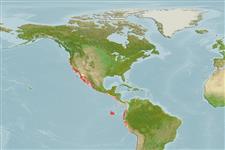
marin benthopélagique; profondeur 100 - 500 m (Ref. 6181), usually 100 - 250 m (Ref. 9351). Deep-water; 46°N - 17°S, 128°W - 75°W (Ref. 6181)
Eastern Pacific: Cape Kiwanda, Oregon, USA to the Gulf of California; then from 5°N to southern Peru.
Taille / Poids / Âge
Maturité: Lm ? range ? - ? cm
Max length : 210 cm SL mâle / non sexé; (Ref. 9351); common length : 150 cm SL mâle / non sexé; (Ref. 9351); poids max. publié: 1.4 kg (Ref. 6181)
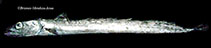
Rayons mous dorsaux (Total) : 78 - 87; Épines anales: 2; Rayons mous anaux: 41 - 50; Vertèbres: 84 - 93. Upper head profile slightly convex, rising gently from snout to dorsal-fin origin. Orbits nearly touching dorsal profile; interorbital space slightly concave. Pelvic fins reduced to 1 scale-like spine and 1 - 2 tiny rays. Pyloric caeca 16 - 18. Color of body is black or brown with a silvery shine along the abdomen.
Body shape (shape guide): elongated; Cross section: compressed.
Benthopelagic on the continental shelf and slope, up to a depth of 400 m or more; generally found over sandy bottoms at a depth between 100 and 250 m (Ref. 9351). During cold season, it is often seen near the surface at nights when the moon is full (Ref. 9351). May also be encountered in surge zones and sometimes observed to be beached in large numbers by the shore (Ref. 9351). A schooling species which feeds on cephalopods, euphausiids and small fishes, including Engraulis mordax and juvenile Merluccius productus. Marketed fresh and frozen (Ref. 9351). Excellent food fish, also processed into fish meal and oil (Ref. 9351).
Cycle de vie et comportement reproducteur
Maturité | Reproduction | Frai | Œufs | Fécondité | Larves
Nakamura, I. and N.V. Parin, 1993. FAO Species Catalogue. Vol. 15. Snake mackerels and cutlassfishes of the world (families Gempylidae and Trichiuridae). An annotated and illustrated catalogue of the snake mackerels, snoeks, escolars, gemfishes, sackfishes, domine, oilfish, cutlassfishes,. scabbardfishes, hairtails, and frostfishes known to date. FAO Fish. Synop. 125(15):136 p. (Ref. 6181)
Statut dans la liste rouge de l'IUCN (Ref. 130435: Version 2025-2 (Global))
Menace pour l'homme
Harmless
Utilisations par l'homme
Pêcheries: intérêt commercial mineur
Outils
Articles particuliers
Télécharger en XML
Sources Internet
Estimations basées sur des modèles
Température préférée (Réf.
123201): 8.2 - 15.4, mean 12.8 °C (based on 70 cells).
Indice de diversité phylogénétique (Réf.
82804): PD
50 = 0.5156 [Uniqueness, from 0.5 = low to 2.0 = high].
Bayesian length-weight: a=0.00275 (0.00104 - 0.00730), b=3.06 (2.83 - 3.29), in cm total length, based on LWR estimates for this (Sub)family-body shape (Ref.
93245).
Niveau trophique (Réf.
69278): 4.1 ±0.59 se; based on food items.
Résilience (Réf.
120179): Faible, temps minimum de doublement de population : 4,5 à 14 années (Preliminary K or Fecundity.).
Vulnérabilité de la pêche (Ref.
59153): Very high vulnerability (90 of 100).
🛈
Nutriments (Ref.
124155): Calcium = 11.5 [5.3, 23.6] mg/100g; Iron = 0.289 [0.135, 0.650] mg/100g; Protein = 17.2 [15.5, 18.8] %; Omega3 = 0.209 [0.095, 0.481] g/100g; Selenium = 30.3 [11.9, 77.8] μg/100g; VitaminA = 8.03 [1.37, 41.90] μg/100g; Zinc = 0.26 [0.17, 0.43] mg/100g (wet weight);