>
Gobiiformes (Gobies) >
Gobiidae (Gobies) > Gobiinae
Etymology: Aphia: Greek, aphia, -as = a kind of plant (Tussilago sp.) (Ref. 45335).
More on author: Risso.
Ambiente: milieu / zona climatica / distribuzione batimetrica / gamma di distribuzione
Ecologia
marino; salmastro pelagic-neritic; oceanodromo (Ref. 51243); distribuzione batimetrica 0 - 97 m (Ref. 57814), usually 5 - 80 m (Ref. 57814). Subtropical; 13°C - 16°C (Ref. 57814); 70°N - 25°N, 13°W - 42°E
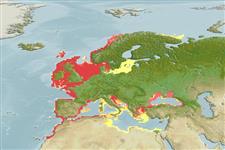
Atlantic Ocean: Trondheim to Morocco. Also known from the Mediterranean including Black Sea and the Azov Sea (Ref. 57814).
Lunghezza alla prima maturità / Dimensione / Peso / Età
Maturità: Lm 3.8, range 3 - ? cm
Max length : 7.9 cm TL maschio/sesso non determinato; (Ref. 26260); Età massima riportata: 1.00 anni (Ref. 232)
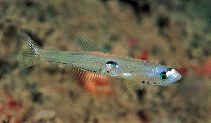
Spine dorsali (totale) : 4 - 6; Raggi dorsali molli (totale) : 11 - 13; Spine anali: 1; Raggi anali molli: 11 - 15. Transparent body, more or less reddish, with chromatophores along bases of median fins and on head. Vertebrae 26-28 (Ref. 232). Males with longer dorsal and anal fins than females (Ref. 35388).
Body shape (shape guide): elongated.
Benthic and free swimming (Ref. 92840). A neotenic, pelagic species inhabiting inshore and estuarine waters, over sand, mud and eel-grass (Ref. 4343). Adults feed on zooplankton, especially copepods, cirripede larvae and mysids (Ref. 4343). They spawn in summer in empty bivalve shells (Ref. 35388). Probably migrate to deeper water to spawn during summer (Ref. 57814). Adults die after breeding (Ref. 4696) which does not qualify as a manifestation of semelparity but abbreviate iteroparity according to a recent study (Ref. 81039). Eggs are pear-shaped (Ref. 4696).
Single spawner, all oocytes in the ovaries grow at a similar rate (Ref. 57814). However, a recent study showed that this species breeds at least twice during its short lifespan with batches of oocytes at different vittelogenic stages in the ovary (Ref. 81039). Reproduction is of the abbreviate iteroparous type with more than one spawning per reproductive season (in spring and summer in older females, in summer and autumn in the yougner ones) (Ref. 81039).
Maugé, L.A., 1986. Gobiidae. p. 358-388. In J. Daget, J.-P. Gosse and D.F.E. Thys van den Audenaerde (eds.) Check-list of the freshwater fishes of Africa (CLOFFA). ISNB, Brussels; MRAC, Tervuren; and ORSTOM, Paris. Vol. 2. (Ref. 4343)
Stato della Lista Rossa IUCN (Ref. 130435: Version 2025-2 (Global))
Minaccia per l'uomo
Harmless
Usi umani
Pesca: commerciale
Strumenti
Rapporti speciali
Scarica XML
Fonti Internet
Stime basate su modelli
Temperatura preferita (Fonte Biblio.
123201): 7.6 - 18.6, mean 10.8 °C (based on 1452 cells).
Indice di diversità filogenetica (Fonte Biblio.
82804): PD
50 = 1.0000 [Uniqueness, from 0.5 = low to 2.0 = high].
Bayesian length-weight: a=0.00575 (0.00506 - 0.00654), b=3.09 (3.05 - 3.13), in cm total length, based on LWR estimates for this species (Ref.
93245).
Livello trofico (Fonte Biblio.
69278): 3.2 ±0.2 se; based on diet studies.
Resilienza (Fonte Biblio.
120179): Alto, tempo minimo di raddoppiamento della popolazione meno di 15 mesi (K>0.3; tm=1; tmax=1; Fec = 935).
Vulnerabilità della pesca (Ref.
59153): Low vulnerability (12 of 100).
🛈
Nutrienti (Ref.
124155): Calcium = 395 [175, 1,059] mg/100g; Iron = 2.75 [1.16, 5.97] mg/100g; Protein = 18.4 [16.2, 20.3] %; Omega3 = 0.294 [0.105, 0.828] g/100g; Selenium = 29.2 [9.5, 91.1] μg/100g; VitaminA = 9.18 [1.88, 40.11] μg/100g; Zinc = 2.41 [1.43, 3.95] mg/100g (wet weight);