>
Ovalentaria/misc (Various families in series Ovalentaria) >
Pomacentridae (Damselfishes) > Microspathodontinae
Etymology: Stegastes: Greek, stegastos, -e, -on = covered (Ref. 45335).
More on authors: Jordan & Rutter.
Ambiente: milieu / zona climatica / distribuzione batimetrica / gamma di distribuzione
Ecologia
marino associati a barriera corallina; non migratori; distribuzione batimetrica 2 - 45 m (Ref. 9710), usually 2 - 5 m (Ref. 9710). Tropical
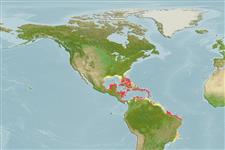
Western Atlantic: southern Florida (USA), Bahamas, and Caribbean Sea. Including Antilles and Yucatan to Venezuela (Ref. 26938).
Dimensione / Peso / Età
Maturità: Lm ? range ? - ? cm
Max length : 12.5 cm TL maschio/sesso non determinato; (Ref. 9710)
Breve descrizione
Chiavi di identificazione | Morfologia | Morfometria
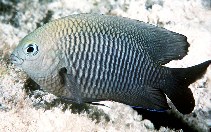
Spine dorsali (totale) : 12; Raggi dorsali molli (totale) : 15 - 16; Spine anali: 2; Raggi anali molli: 13. Anal fin long and pointed, reaching well beyond base of tail (Ref. 26938). Adults dark gray-brown, the edges of the scales blackish; a wash of yellowish often present dorsally on head, nape, and on back below spinous portion of dorsal fin; a small black spot at upper base of pectoral fins; juveniles bright yellow with two bright blue lines dorsally on head, extending to beneath middle of dorsal fin where they break into spots; a large blue-edged black spot basally on dorsal fin centered on last spine (Ref. 13442).
Body shape (shape guide): short and / or deep; Cross section: compressed.
Adults inhabit coral and rocky reefs of sheltered lagoons and inshore areas. Territorial and pugnacious (Ref. 9710). Oviparous, distinct pairing during breeding (Ref. 205). Eggs are demersal and adhere to the substrate (Ref. 205). Males guard and aerate the eggs (Ref. 205). Taken incidentally in traps and small-meshed beach nets (Ref. 5217).
Ciclo vitale e comportamento di accoppiamento
Maturità | Riproduzione | Deposizione | Uova | Fecondità | Larve
Oviparous, distinct pairing during breeding (Ref. 205). Eggs are demersal and adhere to the substrate (Ref. 205). Males guard and aerate the eggs (Ref. 205).
Allen, G.R., 1991. Damselfishes of the world. Mergus Publishers, Melle, Germany. 271 p. (Ref. 7247)
Stato della Lista Rossa IUCN (Ref. 130435: Version 2025-2 (Global))
Minaccia per l'uomo
Harmless
Usi umani
Pesca: commerciale; Acquario: Commerciale
Strumenti
Rapporti speciali
Scarica XML
Fonti Internet
Stime basate su modelli
Temperatura preferita (Fonte Biblio.
123201): 26.1 - 28.2, mean 27.4 °C (based on 688 cells).
Indice di diversità filogenetica (Fonte Biblio.
82804): PD
50 = 0.5000 [Uniqueness, from 0.5 = low to 2.0 = high].
Bayesian length-weight: a=0.02089 (0.00936 - 0.04665), b=2.98 (2.80 - 3.16), in cm total length, based on LWR estimates for this Genus-body shape (Ref.
93245).
Livello trofico (Fonte Biblio.
69278): 2.0 ±0.00 se; based on food items.
Resilienza (Fonte Biblio.
120179): Alto, tempo minimo di raddoppiamento della popolazione meno di 15 mesi (Preliminary K or Fecundity.).
Vulnerabilità della pesca (Ref.
59153): Low vulnerability (10 of 100).
🛈
Nutrienti (Ref.
124155): Calcium = 105 [49, 168] mg/100g; Iron = 0.766 [0.464, 1.312] mg/100g; Protein = 17.9 [16.6, 19.1] %; Omega3 = 0.108 [0.064, 0.178] g/100g; Selenium = 28.4 [14.7, 57.4] μg/100g; VitaminA = 72.8 [16.5, 292.6] μg/100g; Zinc = 1.94 [1.31, 2.92] mg/100g (wet weight);