>
Ovalentaria/misc (Various families in series Ovalentaria) >
Pomacentridae (Damselfishes) > Microspathodontinae
Etymology: Stegastes: Greek, stegastos, -e, -on = covered (Ref. 45335).
More on authors: Jordan & Rutter.
Environnement : milieu / zone climatique / profondeur / gamme de distribution
Écologie
marin récifal; non migrateur; profondeur 2 - 45 m (Ref. 9710), usually 2 - 5 m (Ref. 9710). Tropical
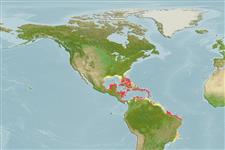
Western Atlantic: southern Florida (USA), Bahamas, and Caribbean Sea. Including Antilles and Yucatan to Venezuela (Ref. 26938).
Taille / Poids / Âge
Maturité: Lm ? range ? - ? cm
Max length : 12.5 cm TL mâle / non sexé; (Ref. 9710)
Description synthétique
Clés d'identification | Morphologie | Morphométrie
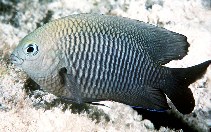
Épines dorsales (Total) : 12; Rayons mous dorsaux (Total) : 15 - 16; Épines anales: 2; Rayons mous anaux: 13. Anal fin long and pointed, reaching well beyond base of tail (Ref. 26938). Adults dark gray-brown, the edges of the scales blackish; a wash of yellowish often present dorsally on head, nape, and on back below spinous portion of dorsal fin; a small black spot at upper base of pectoral fins; juveniles bright yellow with two bright blue lines dorsally on head, extending to beneath middle of dorsal fin where they break into spots; a large blue-edged black spot basally on dorsal fin centered on last spine (Ref. 13442).
Body shape (shape guide): short and / or deep; Cross section: compressed.
Adults inhabit coral and rocky reefs of sheltered lagoons and inshore areas. Territorial and pugnacious (Ref. 9710). Oviparous, distinct pairing during breeding (Ref. 205). Eggs are demersal and adhere to the substrate (Ref. 205). Males guard and aerate the eggs (Ref. 205). Taken incidentally in traps and small-meshed beach nets (Ref. 5217).
Cycle de vie et comportement reproducteur
Maturité | Reproduction | Frai | Œufs | Fécondité | Larves
Oviparous, distinct pairing during breeding (Ref. 205). Eggs are demersal and adhere to the substrate (Ref. 205). Males guard and aerate the eggs (Ref. 205).
Allen, G.R., 1991. Damselfishes of the world. Mergus Publishers, Melle, Germany. 271 p. (Ref. 7247)
Statut dans la liste rouge de l'IUCN (Ref. 130435: Version 2025-2 (Global))
Menace pour l'homme
Harmless
Utilisations par l'homme
Pêcheries: commercial; Aquarium: Commercial
Outils
Articles particuliers
Télécharger en XML
Sources Internet
Estimations basées sur des modèles
Température préférée (Réf.
123201): 26.1 - 28.2, mean 27.4 °C (based on 688 cells).
Indice de diversité phylogénétique (Réf.
82804): PD
50 = 0.5000 [Uniqueness, from 0.5 = low to 2.0 = high].
Bayesian length-weight: a=0.02089 (0.00936 - 0.04665), b=2.98 (2.80 - 3.16), in cm total length, based on LWR estimates for this Genus-body shape (Ref.
93245).
Niveau trophique (Réf.
69278): 2.0 ±0.00 se; based on food items.
Résilience (Réf.
120179): Haut, temps minimum de doublement de population inférieur à 15 mois (Preliminary K or Fecundity.).
Vulnérabilité de la pêche (Ref.
59153): Low vulnerability (10 of 100).
🛈
Nutriments (Ref.
124155): Calcium = 105 [49, 168] mg/100g; Iron = 0.766 [0.464, 1.312] mg/100g; Protein = 17.9 [16.6, 19.1] %; Omega3 = 0.108 [0.064, 0.178] g/100g; Selenium = 28.4 [14.7, 57.4] μg/100g; VitaminA = 72.8 [16.5, 292.6] μg/100g; Zinc = 1.94 [1.31, 2.92] mg/100g (wet weight);