Ambiente: milieu / zona climática / intervalo de profundidade / gama de distribuição
Ecologia
marinhas associadas(os) a recifes; não migratória; intervalo de profundidade 3 - 92 m (Ref. 9710), usually 3 - 35 m (Ref. 40849). Tropical; 37°N - 29°S, 100°W - 28°W (Ref. 55266)
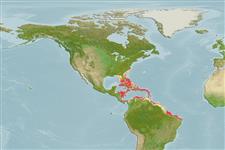
Western Atlantic: Georgia (USA), Bermuda, and northern Gulf of Mexico to Santa Catarina, Brazil (Ref. 57756).
Comprimento na primeira maturidade / Tamanho / Peso / Idade
Maturidade: Lm 15.8 range ? - ? cm
Max length : 35.0 cm TL macho/indeterminado; (Ref. 3797); common length : 30.0 cm TL macho/indeterminado; (Ref. 3797)
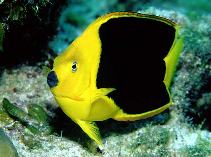
Espinhos dorsais (total) : 14; Raios dorsais moles (total) : 17 - 19; Espinhos anais: 3; Raios anais moles: 18 - 20. Front of body yellow; remaining parts of body, dorsal fin, and front of anal fin black. Caudal fin entirely yellow (Ref. 26938). Front margin of anal fin and edge of gill cover orange; bright blue on upper and lower part of iris. The young of about an inch in length are entirely yellow except for a blue-edged black spot on the upper side of the body posterior to the midpoint; with growth the black spot soon expands to become the large black area covering most of the body and dorsal and anal fins (Ref. 13442).
Body shape (shape guide): short and / or deep; Cross section: compressed.
Inhabits rock jetties, rocky reefs and rich coral areas. Juveniles often associated with fire corals (Ref. 9710). Feeds on tunicates, sponges, zoantharians and algae. Marketed fresh (Ref. 3797).
Ciclo de vida e comportamento de acasalamento
Maturidade | Reprodução | Desova | Ovos | Fecundidade | Larvas
Protogyny has been proposed for this species awaiting confirmation (Ref. 103751).
Allen, G.R., 1985. Butterfly and angelfishes of the world. Vol. 2. 3rd edit. in English. Mergus Publishers, Melle, Germany. (Ref. 4858)
Categoria na Lista Vermelha da IUCN (Ref. 130435: Version 2025-2 (Global))
Ameaça para o homem
Reports of ciguatera poisoning (Ref. 30303)
Utilização humana
Pescarias: pouco comercial; Aquário: Espécies comerciais
Ferramentas
Relatórios especiais
Descarregue XML
Fontes da internet
Estimativas baseadas em modelos
Temperatura preferida (Ref.
123201): 25.4 - 28, mean 27.4 °C (based on 220 cells).
Índice de diversidade filogenética (Ref.
82804): PD
50 = 0.5078 [Uniqueness, from 0.5 = low to 2.0 = high].
Bayesian length-weight: a=0.03236 (0.01713 - 0.06114), b=2.89 (2.72 - 3.06), in cm total length, based on LWR estimates for this species & (Sub)family-body (Ref.
93245).
Nível Trófico (Ref.
69278): 3.0 ±0.0 se; based on diet studies.
Resiliência (Ref.
120179): Médio, tempo mínimo de duplicação da população 1,4 - 4,4 anos (Preliminary K or Fecundity.).
Vulnerabilidade da pesca (Ref.
59153): Low vulnerability (25 of 100).
🛈
Nutrientes (Ref.
124155): Calcium = 42.5 [21.5, 68.9] mg/100g; Iron = 0.511 [0.313, 0.828] mg/100g; Protein = 18.3 [17.1, 19.5] %; Omega3 = 0.104 [0.067, 0.163] g/100g; Selenium = 37 [21, 69] μg/100g; VitaminA = 65 [18, 234] μg/100g; Zinc = 1.23 [0.86, 1.72] mg/100g (wet weight);