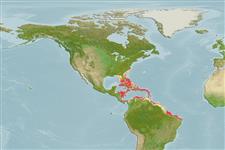
Umwelt: Milieu / Klimazone / Tiefenbereich / Verbreitungsgebiet
Ökologie
seewasser riff-verbunden; standorttreu; tiefenbereich 3 - 92 m (Ref. 9710), usually 3 - 35 m (Ref. 40849). Tropical; 37°N - 29°S, 100°W - 28°W (Ref. 55266)
Western Atlantic: Georgia (USA), Bermuda, and northern Gulf of Mexico to Santa Catarina, Brazil (Ref. 57756).
Länge bei der ersten Reifung / Größe / Gewicht / Alter
Geschlechtsreife: Lm 15.8 range ? - ? cm
Max length : 35.0 cm TL Männchen/unbestimmt; (Ref. 3797); common length : 30.0 cm TL Männchen/unbestimmt; (Ref. 3797)
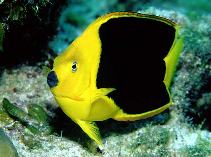
Rückenflossenstacheln (insgesamt) : 14; Rückenflossenweichstrahlen (insgesamt) : 17 - 19; Afterflossenstacheln: 3; Afterflossenweichstrahlen: 18 - 20. Front of body yellow; remaining parts of body, dorsal fin, and front of anal fin black. Caudal fin entirely yellow (Ref. 26938). Front margin of anal fin and edge of gill cover orange; bright blue on upper and lower part of iris. The young of about an inch in length are entirely yellow except for a blue-edged black spot on the upper side of the body posterior to the midpoint; with growth the black spot soon expands to become the large black area covering most of the body and dorsal and anal fins (Ref. 13442).
Body shape (shape guide): short and / or deep; Cross section: compressed.
Inhabits rock jetties, rocky reefs and rich coral areas. Juveniles often associated with fire corals (Ref. 9710). Feeds on tunicates, sponges, zoantharians and algae. Marketed fresh (Ref. 3797).
Lebenszyklus und Paarungsverhalten
Geschlechtsreife | Fortpflanzung | Ablaichen | Eier | Fruchtbarkeit | Larven
Protogyny has been proposed for this species awaiting confirmation (Ref. 103751).
Allen, G.R., 1985. Butterfly and angelfishes of the world. Vol. 2. 3rd edit. in English. Mergus Publishers, Melle, Germany. (Ref. 4858)
IUCN Rote Liste Status (Ref. 130435: Version 2025-2 (Global))
Bedrohung für Menschen
Reports of ciguatera poisoning (Ref. 30303)
Nutzung durch Menschen
Fischereien: weniger kommerziell; Aquarium: Kommerziell
Tools
Zusatzinformationen
Download XML
Internet Quellen
Schätzungen auf der Grundlage von Modellen
Bevorzugte Temperatur (Ref.
123201): 25.4 - 28, mean 27.4 °C (based on 220 cells).
Phylogenetischer Diversitätsindex (Ref.
82804): PD
50 = 0.5078 [Uniqueness, from 0.5 = low to 2.0 = high].
Bayesian length-weight: a=0.03236 (0.01713 - 0.06114), b=2.89 (2.72 - 3.06), in cm total length, based on LWR estimates for this species & (Sub)family-body (Ref.
93245).
Trophische Ebene (Ref.
69278): 3.0 ±0.0 se; based on diet studies.
Widerstandsfähigkeit (Ref.
120179): mittel, Verdopplung der Population dauert 1,4 - 4,4 Jahre. (Preliminary K or Fecundity.).
Anfälligkeit der Fischerei (Ref.
59153): Low vulnerability (25 of 100).
🛈
Nährstoffe (Ref.
124155): Calcium = 42.5 [21.5, 68.9] mg/100g; Iron = 0.511 [0.313, 0.828] mg/100g; Protein = 18.3 [17.1, 19.5] %; Omega3 = 0.104 [0.067, 0.163] g/100g; Selenium = 37 [21, 69] μg/100g; VitaminA = 65 [18, 234] μg/100g; Zinc = 1.23 [0.86, 1.72] mg/100g (wet weight);