>
Scombriformes (Mackerels) >
Bramidae (Pomfrets)
Etymology: Taractichthys: Greek, taraktes = confusion; for the pletora of names that have been applied to this fish + Greek, ichthys = fish (Ref. 45335); longipinnis: longipinnis meaning long-finned (Ref. 4525).
More on author: Lowe.
Environnement : milieu / zone climatique / profondeur / gamme de distribution
Écologie
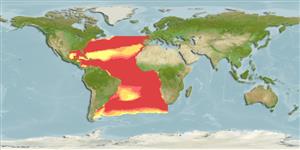
marin pelagic-oceanic; océanodrome (Ref. 87829); profondeur 0 - 500 m (Ref. 89422), usually 42 - 200 m (Ref. 82736). Subtropical; 10°C - ? (Ref. 82736); 47°N - 68°S, 98°W - 21°E
Eastern Atlantic: Iceland and Norway southward to off Pointe Noire, Gulf of Guinea and Namibia; questionably reaching False Bay, South Africa (Ref. 4388). Absent from the Mediterranean (Ref. 4936). Western Atlantic: Nova Scotia, Canada and northern Gulf of Mexico to Puerto Rico (Ref. 7251), Bermuda, northern South America to southeastern Brazil (Ref. 82736). Highly migratory species.
Taille / Poids / Âge
Maturité: Lm ? range ? - ? cm
Max length : 100.0 cm SL mâle / non sexé; (Ref. 6697)
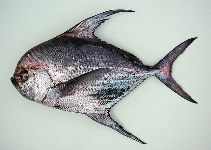
Épines dorsales (Total) : 0; Rayons mous dorsaux (Total) : 33 - 38; Épines anales: 0; Rayons mous anaux: 27 - 30. Grey or silvery in color, with coppery reflections (Ref. 4388).
Body shape (shape guide): short and / or deep.
Generally oceanic and presumably epipelagic. Often solitary but occasionally found in small schools close to shore (Ref. 82736). Feed on shrimps and squids (Ref. 82736). Young are present in all seasons (Ref. 6697). Flesh considered very good (Ref. 3576).
Cycle de vie et comportement reproducteur
Maturité | Reproduction | Frai | Œufs | Fécondité | Larves
Gomes, J., 1990. Bramidae. p. 758-764. In J.C. Quero, J.C. Hureau, C. Karrer, A. Post and L. Saldanha (eds.) Check-list of the fishes of the eastern tropical Atlantic (CLOFETA). JNCT, Lisbon; SEI, Paris; and UNESCO, Paris. Vol. 2. (Ref. 4936)
Statut dans la liste rouge de l'IUCN (Ref. 130435: Version 2025-2 (Global))
Menace pour l'homme
Harmless
Utilisations par l'homme
Pêcheries: intérêt commercial mineur
Outils
Articles particuliers
Télécharger en XML
Sources Internet
Estimations basées sur des modèles
Température préférée (Réf.
123201): 8 - 26.3, mean 17.6 °C (based on 589 cells).
Indice de diversité phylogénétique (Réf.
82804): PD
50 = 0.7500 [Uniqueness, from 0.5 = low to 2.0 = high].
Bayesian length-weight: a=0.01778 (0.00754 - 0.04192), b=2.96 (2.76 - 3.16), in cm total length, based on LWR estimates for this (Sub)family-body shape (Ref.
93245).
Niveau trophique (Réf.
69278): 4.5 ±0.62 se; based on food items.
Résilience (Réf.
120179): Très faible, temps minimum de doublement de population supérieur à 14 ans (Preliminary K or Fecundity.).
Vulnérabilité de la pêche (Ref.
59153): High to very high vulnerability (73 of 100).
🛈
Nutriments (Ref.
124155): Calcium = 34.6 [13.4, 62.3] mg/100g; Iron = 0.868 [0.382, 1.764] mg/100g; Protein = 19.5 [17.6, 21.4] %; Omega3 = 0.316 [0.175, 0.560] g/100g; Selenium = 35.1 [16.0, 71.8] μg/100g; VitaminA = 12.8 [3.1, 51.9] μg/100g; Zinc = 0.458 [0.294, 0.720] mg/100g (wet weight);