Environnement : milieu / zone climatique / profondeur / gamme de distribution
Écologie
; eau douce benthopélagique; pH range: 6.8 - 7.8; dH range: 8 - 18. Temperate; 10°C - 24°C (Ref. 12468); 41°N - 29°N
North America: Mississippi River basin from Ohio and West Virginia to eastern Illinois and south to Louisiana in the USA; Gulf drainages from Black Warrior River in Alabama to Guadalupe River in Texas, USA.
Longueur à la première maturité / Taille / Poids / Âge
Maturité: Lm ?, range 5 - ? cm
Max length : 13.0 cm TL mâle / non sexé; (Ref. 5723); common length : 7.5 cm TL mâle / non sexé; (Ref. 12193); âge max. reporté: 4 années (Ref. 12193)
Description synthétique
Clés d'identification | Morphologie | Morphométrie
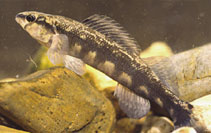
Inhabit fast gravel runs, sometimes riffles, of creeks and small to medium rivers. Often found near brush (Ref. 5723, 10294). Young are found in shallower gravel riffles (Ref. 7043). Juveniles feed on midge and blackfly larvae; adults consume caddisfly and mayfly larvae (Ref. 10294). Males are larger and darker in color during breeding (Ref. 69400).
While in captivity, males exhibit tail-beating while infront of a large female aside from color changes as prespawning behavior (Ref. 69400). 'The generalized condition of a midventral row of specialized scales suggests that the male mounts the female and aligns his body with hers during fertilization and deposition of the eggs' (Ref. 69400).
Page, L.M. and B.M. Burr, 1991. A field guide to freshwater fishes of North America north of Mexico. Houghton Mifflin Company, Boston. 432 p. (Ref. 5723)
Statut dans la liste rouge de l'IUCN (Ref. 130435: Version 2025-2 (Global))
Menace pour l'homme
Harmless
Utilisations par l'homme
Outils
Articles particuliers
Télécharger en XML
Sources Internet
Estimations basées sur des modèles
Indice de diversité phylogénétique (Réf.
82804): PD
50 = 0.5000 [Uniqueness, from 0.5 = low to 2.0 = high].
Bayesian length-weight: a=0.00575 (0.00268 - 0.01234), b=3.13 (2.95 - 3.31), in cm total length, based on LWR estimates for this (Sub)family-body shape (Ref.
93245).
Niveau trophique (Réf.
69278): 3.2 ±0.40 se; based on food items.
Résilience (Réf.
120179): Milieu, temps minimum de doublement de population : 1,4 à 4,4 années (tmax=4; tm=1; Fec=80-196).
Vulnérabilité de la pêche (Ref.
59153): Low vulnerability (10 of 100).
🛈