Klassifizierung / Names
Namen | Synonyme | Catalog of Fishes(Gattung, Arten) | ITIS | CoL | WoRMS | Cloffa
Umwelt: Milieu / Klimazone / Tiefenbereich / Verbreitungsgebiet
Ökologie
; süßwasser benthopelagisch; pH range: ? - 7.0; dH range: 10 - ?; tiefenbereich 0 - 21 m (Ref. 120609). Subtropical; 10°C - 29°C (Ref. 12741); 53°N - 34°N, 104°W - 71°W (Ref. 86798)
North America: St. Lawrence River-Great Lakes, Hudson Bay (Red River), and Mississippi River basins from Quebec to Saskatchewan in Canada, and south to northern Georgia, northern Alabama and Missouri (native only to Meramec River) in the USA (Ref. 86798). Introduced to Europe (Ref. 59043).
Größe / Gewicht / Alter
Geschlechtsreife: Lm ? range ? - ? cm
Max length : 43.0 cm TL Männchen/unbestimmt; (Ref. 86798); common length : 15.4 cm TL Männchen/unbestimmt; (Ref. 12193); max. veröff. Gewicht: 1.4 kg (Ref. 4699); max. veröff. Alter: 18 Jahre (Ref. 72462)
Rückenflossenstacheln (insgesamt) : 10 - 13; Rückenflossenweichstrahlen (insgesamt) : 11 - 13; Afterflossenstacheln: 5 - 7; Afterflossenweichstrahlen: 9 - 11; Wirbelzahl: 29 - 32.
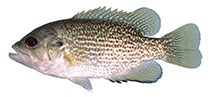
Body shape (shape guide): short and / or deep.
Occurs usually in rocky areas in shallow water of lakes, and the lower, warm reaches of streams (Ref. 1998). Inhabits vegetated and brushy stream margins, pools of creeks and small to medium rivers, and rocky and vegetated margins of lakes (Ref. 86798). Commonly found in clear, silt-free rocky streams (Ref. 86798). Feeds on small crustaceans, insects and fish (Ref. 30578). An introduced species in Europe which avoids swift waters and occurs in a wide variety of slow-flowing to stagnant waters such as large rivers, lakes, ponds, canals and backwaters (Ref. 59043).
The males care about the eggs for about 14 days (Ref. 93240) as well as the young (Ref. 2060). In Europe where it is introduced, males fan and defend the nests, which are shallow depressions in sand or gravel bottom along shallow shores. A male may spawn with several females in one nest and guard the nest until larvae leave the nest (Ref. 59043).
Page, L.M. and B.M. Burr, 2011. A field guide to freshwater fishes of North America north of Mexico. Boston : Houghton Mifflin Harcourt, 663p. (Ref. 86798)
IUCN Rote Liste Status (Ref. 130435: Version 2025-2 (Global))
Bedrohung für Menschen
Harmless
Nutzung durch Menschen
Fischereien: weniger kommerziell; Sportfisch: ja; Aquarium: Öffentliche Aquarien
Tools
Zusatzinformationen
Download XML
Internet Quellen
Schätzungen auf der Grundlage von Modellen
Phylogenetischer Diversitätsindex (Ref.
82804): PD
50 = 0.5625 [Uniqueness, from 0.5 = low to 2.0 = high].
Bayesian length-weight: a=0.01288 (0.01045 - 0.01588), b=3.09 (3.03 - 3.15), in cm total length, based on LWR estimates for this species (Ref.
93245).
Trophische Ebene (Ref.
69278): 3.4 ±0.2 se; based on diet studies.
Generation time: 5.7 ( na - na) years. Estimated as median ln(3)/K based on 2
growth studies.
Widerstandsfähigkeit (Ref.
120179): niedrig, Verdopplung der Population dauert 4,5 - 14 Jahre. (K=0.19-0.23; tm=2-5; tmax=18; Fec=3,000-11,000).
Anfälligkeit der Fischerei (Ref.
59153): Moderate vulnerability (41 of 100).
🛈