>
Cyprinodontiformes (Rivulines, killifishes and live bearers) >
Poeciliidae (Poeciliids) > Poeciliinae
Etymology: Poecilia: Greek, poikilos = with a lot of colours (Ref. 45335).
More on author: Girard.
Miljö: miljö / Klimatzon / djupintervall / distributionsområde
Ekologi
; sötvatten; brackvatten bentopelagisk; ej vandrande (Ref. 126106). Subtropical; 27°N - 25°N
North America: lower Nueces River (where possibly introduced) and lower Rio Grande, extreme southern Texas, to Veracruz in Mexico. Introduced populations at San Antonio and San Marcos, Texas.
Storlek / Vikt / Ålder
Könsmognad: Lm ? range ? - ? cm
Max length : 9.6 cm TL hane/ej könsbestämd; (Ref. 5723); common length : 5.5 cm TL hane/ej könsbestämd; (Ref. 12193)
Kort beskrivning
Bestämningsnycklar | Morfologi | Morfometri
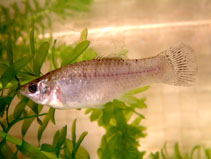
Taggstrålar i ryggfenan (totalt) : 0; Mjukstrålar i ryggfenan (totalt) : 10 - 12. Similar to females of P. latipinna but lacks rows of brown spots on side (may have row of dusky black spots).
Body shape (shape guide): fusiform / normal; Cross section: oval.
Adults are found in backwaters and quiet pools of streams, sloughs, and ditches, usually over mud. This is an all-female species thought to have originated as a result of hybridization between P. latipinna and P. sphenops. Gynogenesis reproduction is triggered by copulation and stimulation by sperm from males of other species in the genus, either P. latipinna, P. mexicana, P. latipunctata, or rarely P. sphenops.
Livscykel och parningsbeteende
Könsmognad | Reproduktion | Lek | Ägg | Fekunditet | Larver
Reproduces gynogenetically (Refs. 8601, 8602, 8605, 5723, 125602), meaning once the sperm has penetrated the egg membrane, it takes no further part in the development of the embryo. Eggs develop following copulation and stimulation by sperm from males of other species in the genus, either P. latipinna, P. mexicana, P. latipunctata, or rarely P. sphenops. Viviparous (Ref. 8601), but there is no nutritional contribution by the mother during embryonic development to compensate for the depletion of stored reserves in the egg as embryos develop (Ref. 8606).
Meyer, M.K. and A.C. Radda, 2000. Notes on the subgenus Mollienesia Lesueur,1821, with a description of a new species of Poecilia Bloch & Schneider, 1801 (Cyprinodontiformes: Poeciliidae) from Venezuela. Ann. Naturhist. Mus. Wien 102B:75-81. (Ref. 42987)
Status på IUCN:s rödlista (Ref. 130435: Version 2025-2 (Global))
Hot mot människor
Harmless
Mänskliga användningsområden
Fiskeri: saknar intresse; Akvarium: Kommersiell
Verktyg
Särskilda rapporter
Ladda ner XML
Internet-källor
Uppskattningar baserade på modeller
Index för fylogenetisk mångfald (Ref.
82804): PD
50 = 0.5000 [Uniqueness, from 0.5 = low to 2.0 = high].
Bayesian length-weight: a=0.01288 (0.00551 - 0.03009), b=3.14 (2.96 - 3.32), in cm total length, based on LWR estimates for this Genus-body shape (Ref.
93245).
Trofisk nivå (Ref.
69278): 2.5 ±0.3 se; based on size and trophs of closest relatives
Resiliens (Ref.
120179): Mellan, lägsta populationsfördubblingstid 1,4-4,4 år (Preliminary K or Fecundity.).
Sårbarhet i fisket (Ref.
59153): Low vulnerability (10 of 100).
🛈