>
Cyprinodontiformes (Rivulines, killifishes and live bearers) >
Poeciliidae (Poeciliids) > Poeciliinae
Etymology: Poecilia: Greek, poikilos = with a lot of colours (Ref. 45335).
More on author: Girard.
Περιβάλλον: περιβάλλον / κλιματική ζώνη / εύρος βάθους / εύρος διανομής
Οικολογία
; Γλυκού νερού; Υφάλμυρο βενθοπελαγικό; μη μεταναστευτικό(ά) (Ref. 126106). Subtropical; 27°N - 25°N
North America: lower Nueces River (where possibly introduced) and lower Rio Grande, extreme southern Texas, to Veracruz in Mexico. Introduced populations at San Antonio and San Marcos, Texas.
Μέγεθος / Βάρος / Ηλικία
Γεννητική Ωρίμανση: Lm ? range ? - ? cm
Max length : 9.6 cm TL αρσενικό/απροσδιόριστο; (Ref. 5723); common length : 5.5 cm TL αρσενικό/απροσδιόριστο; (Ref. 12193)
Σύντομη περιγραφή
Κλείδες προσδιορισμού | Μορφολογία | Μορφομετρία
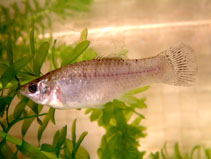
Ραχιαίες άκανθες (συνολικά) : 0; Μαλακές ραχιαίες ακτίνες (συνολικά) : 10 - 12. Similar to females of P. latipinna but lacks rows of brown spots on side (may have row of dusky black spots).
Body shape (shape guide): fusiform / normal; Cross section: oval.
Adults are found in backwaters and quiet pools of streams, sloughs, and ditches, usually over mud. This is an all-female species thought to have originated as a result of hybridization between P. latipinna and P. sphenops. Gynogenesis reproduction is triggered by copulation and stimulation by sperm from males of other species in the genus, either P. latipinna, P. mexicana, P. latipunctata, or rarely P. sphenops.
Κύκλος ζωής και συμπεριφορά ζευγαρώματος
Γεννητική Ωρίμανση | Αναπαραγωγή | Γεννοβολία | Αβγά | Γονιμότητα | Προνύμφες
Reproduces gynogenetically (Refs. 8601, 8602, 8605, 5723, 125602), meaning once the sperm has penetrated the egg membrane, it takes no further part in the development of the embryo. Eggs develop following copulation and stimulation by sperm from males of other species in the genus, either P. latipinna, P. mexicana, P. latipunctata, or rarely P. sphenops. Viviparous (Ref. 8601), but there is no nutritional contribution by the mother during embryonic development to compensate for the depletion of stored reserves in the egg as embryos develop (Ref. 8606).
Meyer, M.K. and A.C. Radda, 2000. Notes on the subgenus Mollienesia Lesueur,1821, with a description of a new species of Poecilia Bloch & Schneider, 1801 (Cyprinodontiformes: Poeciliidae) from Venezuela. Ann. Naturhist. Mus. Wien 102B:75-81. (Ref. 42987)
Κατάσταση Κόκκινου Καταλόγου IUCN (Ref. 130435: Version 2025-2 (Global))
Απειλή για τον άνθρωπο
Harmless
Ανθρώπινες χρήσεις
αλιεία: χωρίς ενδιαφέρον; Ενυδρείο: Εμπορικό(ά)
Εργαλεία
Ειδικές εκθέσεις
Λήψη XML
Διαδικτυακές πηγές
Εκτιμήσεις βάσει μοντέλων
Δείκτης φυλογενετικής ποικιλότητας (Αναφ.
82804): PD
50 = 0.5000 [Uniqueness, from 0.5 = low to 2.0 = high].
Bayesian length-weight: a=0.01288 (0.00551 - 0.03009), b=3.14 (2.96 - 3.32), in cm total length, based on LWR estimates for this Genus-body shape (Ref.
93245).
Τροφικό Επίπεδο (Αναφ.
69278): 2.5 ±0.3 se; based on size and trophs of closest relatives
Ελαστικότητα (Αναφ.
120179): Μεσαίο(α), ελάχιστος χρόνος για διπλασιασμό πληθυσμού 1,4 - 4,4 έτη (Preliminary K or Fecundity.).
Ευπάθεια στην αλιεία (Ref.
59153): Low vulnerability (10 of 100).
🛈