分类 / 名称
俗名 | 同种异名 | Catalog of Fishes(属, 种) | ITIS | CoL | WoRMS | Cloffa
Teleostei >
Perciformes/Zoarcoidei (Eelpouts and pricklebacks) >
Zoarcidae (Eelpouts) > Lycodinae
Etymology: Lycodes: Greek, lykos = wolf + Greek, suffix, oides = similar to (Ref. 45335); diapterus: From the Greek di and apteros meaning 'two' and 'fin' (Ref. 27436).
More on author: Gilbert.
环境:氛围 / 气候带 / 深度上下限 / 分布范围
生态学
海洋 深海底的; 深度上下限 146 - 844 m (Ref. 80505), usually 300 - 600 m (Ref. 80505). 深水域
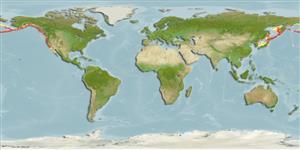
North Pacific: Southern California west of the Channel Islands north along the North American coast to the Pacific side of Vancouver Island; apparently not present in the Strait of Georgia or Puget Sound, and has been reported as far south as San Diego.
北太平洋: 到在 Aleutian 鏈與聖地牙哥,美國的 Attu 島的到白令海的拿瓦倫峽谷的日本海。
大小 / 重量 / 年龄
成熟度: Lm ? range ? - ? cm
Max length : 33.0 cm TL 雄鱼/尚未辨别雌雄; (Ref. 2850)
背棘 (总数) : 0; 背的软条 (总数) : 109 - 118; 臀棘: 0; 臀鳍软条: 99 - 109; 脊椎骨: 118 - 126. This species is distinguished by the following: with scales covering the nape and the entire postorbital dorsal surface of the head (in adults 15.0 cm SL and larger): it differs from L. beringi in having higher counts of dorsal-fin ray (usually 111 or more), anal-fin ray (usually 100 or more), vertebral (usually 119 or more), and gill raker (usually 15 or more); differs from L. hubbsi in having 19-21 pectoral-fin rays (vs. 20-23), position of the first dorsal-fin
pterygiophore at the sixth or seventh interneural gap (vs. third), and color pattern, for it lacks narrow light bands extending onto dorsal fin and across nape; differs from the 'L. nakamurae group’’ (nakamurae, pectoralis, nishimurai) in having 4 postorbital pores (vs. 1 or 2), the posteriormost without a short tube; lower pectoral-fin lobe rounded, the tips of the rays rounded and the middle rays often branched, fin membrane not incised (vs. pointed, with rays pointed and unbranched, membrane moderately incised); scales often present on base of pectoral fin; light inverted V-shaped bands usually present on body (Ref. 80505).
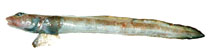
Body shape (shape guide): eel-like; Cross section: oval.
尾部的不清楚地可与背鳍与臀鳍区别; 在中央中的胸鳍有凹槽的; 腹鳍小的.(参考文献 6885) 腹地的暗褐色的在背面上又蓝色的黑色; 在鳞片上的细突出的淡色斑点; 在背鳍上延伸的身体侧边上的 8 或 9个淡的纵带而且在身体下半部上传布或分开, 变成模糊或消失当成鱼时; 在胸鳍,腹鳍与臀鳍上的蓝色的黑色; 在嘴与鳃腔的衬里上的蓝色的黑色; 暗色到黑色的在腹膜上.(参考文献 6885)
Found on muddy bottoms (Ref. 2850). May be used as bait (Ref. 27436). Flesh considered firm and tasty but not esteemed (Ref. 27436).
栖息于泥底部了。 (参考文献 2850) 可能是当作鱼饵使用。 (参考文献 27436) 肉被认为是结实而好吃的但是不赞赏.(参考文献 27436)
生命周期和交配行为
成熟度 | 繁殖 | 产卵场 | 卵 | 孕卵数 | 仔鱼
北太平洋: 到在 Aleutian 鏈與聖地牙哥,美國的 Attu 島的到白令海的拿瓦倫峽谷的日本海。
Anderson, M.E., 1994. Systematics and osteology of the Zoarcidae (Teleostei: Perciformes). Ichthyol. Bull. J.L.B. Smith Inst. Ichthyol. 60:120 p. (Ref. 11954)
世界自然保护联盟红皮书 (Ref. 130435: Version 2025-2 (Global))
人类利用
渔业: 自给性渔业
工具
特别资料
下载 XML
网络资源
基于模型的估算
首选温度 (参考文献
123201): 0.8 - 5.4, mean 3.2 °C (based on 128 cells).
系统发育多样性指数 (参考文献
82804): PD
50 = 0.5000 [Uniqueness, from 0.5 = low to 2.0 = high].
Bayesian length-weight: a=0.00120 (0.00057 - 0.00253), b=3.10 (2.91 - 3.29), in cm total length, based on LWR estimates for this (Sub)family-body shape (Ref.
93245).
营养阶层 (参考文献
69278): 3.4 ±0.4 se; based on size and trophs of closest relatives
回复力 (参考文献
120179): 低的, 最小族群倍增时间4.5 - 14 年 (Preliminary K or Fecundity.).
渔业脆弱性 (Ref.
59153): Low vulnerability (23 of 100).
🛈