>
Perciformes/Zoarcoidei (Eelpouts and pricklebacks) >
Zoarcidae (Eelpouts) > Lycodinae
Etymology: Lycodes: Greek, lykos = wolf + Greek, suffix, oides = similar to (Ref. 45335); diapterus: From the Greek di and apteros meaning 'two' and 'fin' (Ref. 27436).
More on author: Gilbert.
Meio ambiente: milieu / Zona climática / intervalo de profundidade / faixa de distribuição
Ecologia
marinhas batidemersal; intervalo de profundidade 146 - 844 m (Ref. 80505), usually 300 - 600 m (Ref. 80505). Deep-water
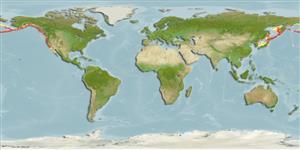
North Pacific: Southern California west of the Channel Islands north along the North American coast to the Pacific side of Vancouver Island; apparently not present in the Strait of Georgia or Puget Sound, and has been reported as far south as San Diego.
Tamanho / Peso / Idade
Maturidade: Lm ? range ? - ? cm
Max length : 33.0 cm TL macho/indeterminado; (Ref. 2850)
Descrição suscinta
Chaves de identificação | Morfologia | Morfometria
Espinhos dorsais (total) : 0; Raios dorsais (total) : 109 - 118; Espinhos anais: 0; Raios anais : 99 - 109; Vértebras: 118 - 126. This species is distinguished by the following: with scales covering the nape and the entire postorbital dorsal surface of the head (in adults 15.0 cm SL and larger): it differs from L. beringi in having higher counts of dorsal-fin ray (usually 111 or more), anal-fin ray (usually 100 or more), vertebral (usually 119 or more), and gill raker (usually 15 or more); differs from L. hubbsi in having 19-21 pectoral-fin rays (vs. 20-23), position of the first dorsal-fin
pterygiophore at the sixth or seventh interneural gap (vs. third), and color pattern, for it lacks narrow light bands extending onto dorsal fin and across nape; differs from the 'L. nakamurae group’’ (nakamurae, pectoralis, nishimurai) in having 4 postorbital pores (vs. 1 or 2), the posteriormost without a short tube; lower pectoral-fin lobe rounded, the tips of the rays rounded and the middle rays often branched, fin membrane not incised (vs. pointed, with rays pointed and unbranched, membrane moderately incised); scales often present on base of pectoral fin; light inverted V-shaped bands usually present on body (Ref. 80505).
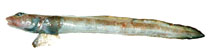
Body shape (shape guide): eel-like; Cross section: oval.
Found on muddy bottoms (Ref. 2850). May be used as bait (Ref. 27436). Flesh considered firm and tasty but not esteemed (Ref. 27436).
Ciclo de vida ou comportamento de acasalamento
Maturidade | Reprodução | Desova | Ovos | Fecundidade | Larvas
Anderson, M.E., 1994. Systematics and osteology of the Zoarcidae (Teleostei: Perciformes). Ichthyol. Bull. J.L.B. Smith Inst. Ichthyol. 60:120 p. (Ref. 11954)
Status na Lista Vermelha da UICN (Ref. 130435: Version 2025-2 (Global))
Ameaça para os humanos
Harmless
Uso pelos humanos
Pescarias: pesca de subsistência
Ferramentas
Relatórios especiais
Baixar XML
Fontes da internet
Estimativas baseadas em modelos
Temperatura preferida (Ref.
123201): 0.8 - 5.4, mean 3.2 °C (based on 128 cells).
Índice de diversidade filogenética (Ref.
82804): PD
50 = 0.5000 [Uniqueness, from 0.5 = low to 2.0 = high].
Bayesian length-weight: a=0.00120 (0.00057 - 0.00253), b=3.10 (2.91 - 3.29), in cm total length, based on LWR estimates for this (Sub)family-body shape (Ref.
93245).
Nível Trófico (Ref.
69278): 3.4 ±0.4 se; based on size and trophs of closest relatives
Resiliência (Ref.
120179): Baixo, tempo mínimo de duplicação da população 4,5 - 14 anos (Preliminary K or Fecundity.).
Vulnerabilidade da pesca (Ref.
59153): Low vulnerability (23 of 100).
🛈