>
Ophidiiformes (Cusk eels) >
Bythitidae (Livebearing brotulas)
Etymology: Brosmophycis: Greek, brosomai, bibrosko = to eat up, to devour + Greek, phykis = a fish that lives among alga (Greek, phyke) + Greek, ops =appearance (Ref. 45335); marginata: marginatus meaning edged (Ref. 6885).
More on author: Ayres.
Environnement : milieu / zone climatique / profondeur / gamme de distribution
Écologie
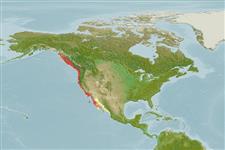
marin démersal; profondeur 3 - 256 m (Ref. 2850), usually 15 - ? m (Ref. 2850). Subtropical; 59°N - 14°N, 137°W - 92°W
Eastern Pacific: Petersburg, southeastern Alaska to Ensenada, northern Baja California, Mexico.
Taille / Poids / Âge
Maturité: Lm ? range ? - ? cm
Max length : 46.0 cm TL mâle / non sexé; (Ref. 2850)
Description synthétique
Clés d'identification | Morphologie | Morphométrie
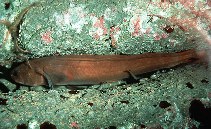
Épines dorsales (Total) : 0; Rayons mous dorsaux (Total) : 98 - 110; Épines anales: 0; Rayons mous anaux: 72 - 81; Vertèbres: 63 - 65. Dorsal fin base covered with loose skin; caudal small and rounded; anal fin base covered with skin; pectorals rounded, almost pedunculate; two pelvic fin rays, outer ray of pelvic fins long, slender and filamentous, twice the length of inner ray (Ref. 6885). Bright red to brown on dorsal surface, nearly white on ventral surface of the body; pale red on ventral surface of head; margins of dorsal and anal fins red; bright red on caudal and pectoral fins; lips pink; mucus secretion reddish (Ref. 6885). Branchiostegal rays: 7 (Ref. 36488).
Body shape (shape guide): elongated.
A common cryptic species (Ref. 34024). Found in rocky areas (Ref. 2850). Live-bearers with planktonic larvae (Ref. 36488). Flesh considered sweet and fine-textured but rarely available (Ref. 27436).
Ovoviviparous (Ref. 205).
Nielsen, J.G., D.M. Cohen, D.F. Markle and C.R. Robins, 1999. Ophidiiform fishes of the world (Order Ophidiiformes). An annotated and illustrated catalogue of pearlfishes, cusk-eels, brotulas and other ophidiiform fishes known to date. FAO Fish. Synop. 125(18):178p. Rome: FAO. (Ref. 34024)
Statut dans la liste rouge de l'IUCN (Ref. 130435: Version 2025-2 (Global))
Menace pour l'homme
Harmless
Utilisations par l'homme
Pêcheries: commercial; Aquarium: Aquariums publics
Outils
Articles particuliers
Télécharger en XML
Sources Internet
Estimations basées sur des modèles
Température préférée (Réf.
123201): 7.7 - 23.3, mean 10.8 °C (based on 234 cells).
Indice de diversité phylogénétique (Réf.
82804): PD
50 = 1.0000 [Uniqueness, from 0.5 = low to 2.0 = high].
Bayesian length-weight: a=0.00479 (0.00192 - 0.01191), b=3.03 (2.81 - 3.25), in cm total length, based on LWR estimates for this (Sub)family-body shape (Ref.
93245).
Niveau trophique (Réf.
69278): 3.6 ±0.5 se; based on size and trophs of closest relatives
Résilience (Réf.
120179): Milieu, temps minimum de doublement de population : 1,4 à 4,4 années (Fec=200).
Vulnérabilité de la pêche (Ref.
59153): Moderate vulnerability (36 of 100).
🛈