>
Ophidiiformes (Cusk eels) >
Bythitidae (Livebearing brotulas)
Etymology: Brosmophycis: Greek, brosomai, bibrosko = to eat up, to devour + Greek, phykis = a fish that lives among alga (Greek, phyke) + Greek, ops =appearance (Ref. 45335); marginata: marginatus meaning edged (Ref. 6885).
More on author: Ayres.
Milieu: milieu / Klimaatzone / Diepte / verspreidingsgebied
Ecologie
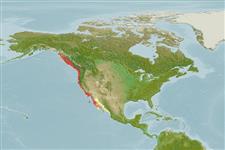
marien demersaal; diepte 3 - 256 m (Ref. 2850), usually 15 - ? m (Ref. 2850). Subtropical; 59°N - 14°N, 137°W - 92°W
Eastern Pacific: Petersburg, southeastern Alaska to Ensenada, northern Baja California, Mexico.
Grootte / Gewicht / Leeftijd
Maturiteit: Lm ? range ? - ? cm
Max length : 46.0 cm TL mannelijk / geslacht onbekend; (Ref. 2850)
Korte beschrijving
Determinatiesleutels | Morfologie | Morfometrie
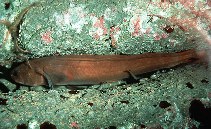
Dorsale stekels (totaal) : 0; Dorsale zachte stralen (totaal) : 98 - 110; Anale stekels: 0; Anale zachte stralen: 72 - 81; Wervels: 63 - 65. Dorsal fin base covered with loose skin; caudal small and rounded; anal fin base covered with skin; pectorals rounded, almost pedunculate; two pelvic fin rays, outer ray of pelvic fins long, slender and filamentous, twice the length of inner ray (Ref. 6885). Bright red to brown on dorsal surface, nearly white on ventral surface of the body; pale red on ventral surface of head; margins of dorsal and anal fins red; bright red on caudal and pectoral fins; lips pink; mucus secretion reddish (Ref. 6885). Branchiostegal rays: 7 (Ref. 36488).
Body shape (shape guide): elongated.
A common cryptic species (Ref. 34024). Found in rocky areas (Ref. 2850). Live-bearers with planktonic larvae (Ref. 36488). Flesh considered sweet and fine-textured but rarely available (Ref. 27436).
Ovoviviparous (Ref. 205).
Nielsen, J.G., D.M. Cohen, D.F. Markle and C.R. Robins, 1999. Ophidiiform fishes of the world (Order Ophidiiformes). An annotated and illustrated catalogue of pearlfishes, cusk-eels, brotulas and other ophidiiform fishes known to date. FAO Fish. Synop. 125(18):178p. Rome: FAO. (Ref. 34024)
Status op de Rode Lijst van het IUCN (Ref. 130435: Version 2025-2 (Global))
Gevaar voor de mens
Harmless
Gebruik door de mens
Visserij: commercieel; Aquarium: Publieke aquaria
Tools
Speciale rapporten
Download XML
Internetbronnen
Schattingen op basis van modellen
Gewenste temperatuur (Ref.
123201): 7.7 - 23.3, mean 10.8 °C (based on 234 cells).
Fylogenetische diversiteitsindex (Ref.
82804): PD
50 = 1.0000 [Uniqueness, from 0.5 = low to 2.0 = high].
Bayesian length-weight: a=0.00479 (0.00192 - 0.01191), b=3.03 (2.81 - 3.25), in cm total length, based on LWR estimates for this (Sub)family-body shape (Ref.
93245).
Trofisch niveau (Ref.
69278): 3.6 ±0.5 se; based on size and trophs of closest relatives
Weerstandsvermogen (Ref.
120179): Gemiddeld, minimale populatieverdubbelingstijd 1,4-4,4 jaar (Fec=200).
Kwetsbaarheid van de visserij (Ref.
59153): Moderate vulnerability (36 of 100).
🛈