>
Gadiformes (Cods) >
Phycidae (Phycid hakes)
Etymology: Urophycis: Greek, oura = tail + Greek, phyke, pykis, -idos = the female of a fish that lives among algae (Greek = phykon), related with the gudgeon (Ref. 45335).
More on author: Walbaum.
Entorno: milieu / zona climática / rango de profundidad / gama de distribución
Ecología
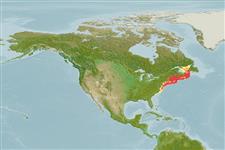
marino demersal; oceanodromo (Ref. 51243); rango de profundidad 35 - 1152 m (Ref. 57178), usually 110 - 130 m. Temperate; 51°N - 33°N, 79°W - 58°W
Northwest Atlantic: North Carolina to southern Nova Scotia, straying to the Gulf of St. Lawrence. Rare European records are probably misidentifications of Urophycis tenuis.
Longitud en la primera madurez / Tamaño / Peso / Edad
Madurez: Lm 26.0 range ? - ? cm
Max length : 66.0 cm TL macho / no sexado; (Ref. 40637); peso máximo publicado: 3.6 kg (Ref. 40637)
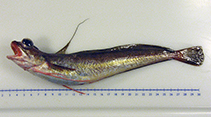
Espinas dorsales (total) : 0; Espinas anales: 0. First dorsal fin ray elongated. Pelvic fins also reaching about the anal fin origin. Body color variable, reddish to olive brown dorsally, sometimes very dark or mottled; lower sides paler, sometimes with dusky dots; belly and underside of the head pale. A dusky blotch present on the opercle. The fins are generally dark, except for the pelvic fins, which are pale.
Body shape (shape guide): elongated; Cross section: circular.
Found on soft muddy and sandy bottoms, but never on rocks, gravel or shells. Juveniles live along the coasts at shallow depths (4-6 m); adults migrate to deeper waters, generally to between 110 and 130 m, and in some instances, to over 550 m. Juveniles live in scallops (Placopecten magellanicus) and remain close to scallop beds until they mature (Ref. 9988). They prefer temperatures of 8-10°C (Ref. 5951). Feed on shrimps, amphipods and other crustaceans, also on squid and herring, flatfish, mackerel and others. Utilized fresh, dried or salted and frozen; also small fish are used for fishmeal ; eaten steamed, microwaved and baked (Ref. 9988). Maximum depth reported from Ref. 57178.
Cohen, D.M., T. Inada, T. Iwamoto and N. Scialabba, 1990. FAO species catalogue. Vol. 10. Gadiform fishes of the world (Order Gadiformes). An annotated and illustrated catalogue of cods, hakes, grenadiers and other gadiform fishes known to date. FAO Fish. Synop. 125(10). Rome: FAO. 442 p. (Ref. 1371)
Situación en la Lista Roja de la UICN (Ref. 130435: Version 2025-2 (Global))
Amenaza para el ser humano
Harmless
Usos humanos
Pesquerías: comercial; pesca deportiva: si
Herramientas
Informes especiales
Descargar XML
Fuentes de Internet
Estimaciones basadas en modelos
Temperatura preferida (Referencia
123201): 1.6 - 11.1, mean 5 °C (based on 23 cells).
Índice de diversidad filogenética (Referencia
82804): PD
50 = 0.5044 [Uniqueness, from 0.5 = low to 2.0 = high].
Bayesian length-weight: a=0.00417 (0.00327 - 0.00532), b=3.11 (3.04 - 3.18), in cm total length, based on LWR estimates for this species (Ref.
93245).
Nivel trófico (Referencia
69278): 3.7 ±0.3 se; based on diet studies.
Generation time: 5.8 ( na - na) years. Estimated as median ln(3)/K based on 1
growth studies.
Resiliencia (Referencia
120179): Medio, población duplicada en un tiempo mínimo de 1.4-4.4 años (K=0.19; tm=2-3).
Prior r = 0.20, 95% CL = 0.13 - 0.30, Based on 3 full stock assessments.
Vulnerabilidad pesquera (Ref.
59153): Moderate to high vulnerability (51 of 100).
🛈
Vulnerabilidad climática (Ref.
125649): Moderate to high vulnerability (52 of 100).
🛈
Nutrientes (Ref.
124155): Calcium = 27.7 [17.1, 58.1] mg/100g; Iron = 0.353 [0.196, 0.651] mg/100g; Protein = 17.2 [16.0, 18.5] %; Omega3 = 0.412 [0.217, 0.750] g/100g; Selenium = 25.8 [13.2, 49.7] μg/100g; VitaminA = 16.2 [4.3, 55.6] μg/100g; Zinc = 0.435 [0.306, 0.627] mg/100g (wet weight);