>
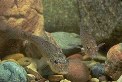
Percopsiformes (Trout-perches, pirate perches and cavefishes) >
Percopsidae (Trout-perches)
Etymology: Percopsis: Greek, perke = perch + Greek, opsis = appearance (Ref. 45335); omiscomaycus: omiscomaycus which is probably an Algonkian Indian name that includes the root 'trout' (Ref. 1998).
More on author: Walbaum.
Milieu: milieu / Klimaatzone / Diepte / verspreidingsgebied
Ecologie
; zoet water demersaal; potamodroom (Ref. 126106); diepte 10 - 61 m (Ref. 27547). Temperate; 68°N - 37°N
North America: Atlantic and Arctic basins throughout most of Canada, and south to Potomac River drainage in Virginia, USA; Yukon River drainage in Yukon Territory and Alaska; Great Lakes and Mississippi River basins south to West Virginia, Kentucky, Illinois, Missouri, North Dakota and Montana in the USA.
Lengte bij maturiteit / Grootte / Gewicht / Leeftijd
Maturiteit: Lm 11.4, range 8 - 15.4 cm
Max length : 20.0 cm TL mannelijk / geslacht onbekend; (Ref. 5723); common length : 8.8 cm TL mannelijk / geslacht onbekend; (Ref. 12193); max. gerapporteerde leeftijd: 4 Jaren (Ref. 10348)
Korte beschrijving
Determinatiesleutels | Morfologie | Morfometrie
Dorsale stekels (totaal) : 1 - 3; Dorsale zachte stralen (totaal) : 9 - 11; Anale stekels: 1; Anale zachte stralen: 5 - 9; Wervels: 33 - 36. Distinguished by the presence of an adipose fin; small weak spines in the dorsal and anal spines; rough ctenoid scales; and pectoral fins reaching well behind the bases of pelvic fins (Ref. 27547). Gill rakers short, stubby mounds with small teeth; lateral line nearly straight (Ref. 27547). Pale yellowish to silvery, often almost transparent; with a row of about 10 dark spots along midline of back, 10 or 11 spots along lateral line, and another row of spots high on sides above lateral line; fins transparent (Ref. 27547).
Body shape (shape guide): elongated.
Adults occur in lakes, deep flowing pools of creeks, and rivers (Ref. 5723). Usually found over sand (Ref. 5723). They move into the shallows of lakes at night to feed and moves back to deeper water as dawn approaches (Ref. 1998). They feed on insect larvae, amphipods and fishes (Ref. 1998). Important forage fish (Ref. 1998).
Spawning adults move inshore to shallow water or into shallow tributaries of lakes (Ref. 10348). Two or more males cluster with a single female near the surface. They press close to the female, often breaking the surface of the water, and eggs and milt are released (Ref. 27547). Some populations spawn exclusively at night (Ref. 10348), but others show no variation from daytime spawning (Ref. 10349). There is often, perhaps usually, heavy postspawning mortality (Ref. 27547).
Page, L.M. and B.M. Burr, 1991. A field guide to freshwater fishes of North America north of Mexico. Houghton Mifflin Company, Boston. 432 p. (Ref. 5723)
Status op de Rode Lijst van het IUCN (Ref. 130435: Version 2025-2 (Global))
Gevaar voor de mens
Harmless
Gebruik door de mens
Visserij: van geen belang; Aquarium: Publieke aquaria; aas: occasionally
Tools
Speciale rapporten
Download XML
Internetbronnen
Schattingen op basis van modellen
Fylogenetische diversiteitsindex (Ref.
82804): PD
50 = 1.0002 [Uniqueness, from 0.5 = low to 2.0 = high].
Bayesian length-weight: a=0.00589 (0.00251 - 0.01382), b=3.12 (2.90 - 3.34), in cm total length, based on LWR estimates for this species & (Sub)family-body (Ref.
93245).
Trofisch niveau (Ref.
69278): 3.4 ±0.51 se; based on food items.
Weerstandsvermogen (Ref.
120179): Gemiddeld, minimale populatieverdubbelingstijd 1,4-4,4 jaar (tm=2-3; tmax=4).
Kwetsbaarheid van de visserij (Ref.
59153): Low to moderate vulnerability (30 of 100).
🛈