>
Percopsiformes (Trout-perches, pirate perches and cavefishes) >
Percopsidae (Trout-perches)
Etymology: Percopsis: Greek, perke = perch + Greek, opsis = appearance (Ref. 45335); omiscomaycus: omiscomaycus which is probably an Algonkian Indian name that includes the root 'trout' (Ref. 1998).
More on author: Walbaum.
Lingkungan: lingkungan / zona iklim / kisaran kedalaman / jangkauan distribusi
Ekologi
; air tawar dasar (demersal); potamodromous (Ref. 126106); kisaran kedalaman 10 - 61 m (Ref. 27547). Temperate; 68°N - 37°N
North America: Atlantic and Arctic basins throughout most of Canada, and south to Potomac River drainage in Virginia, USA; Yukon River drainage in Yukon Territory and Alaska; Great Lakes and Mississippi River basins south to West Virginia, Kentucky, Illinois, Missouri, North Dakota and Montana in the USA.
Panjang pada saat jatuh tempo pertama / Ukuran / Berat / umur
Kematangan: Lm 11.4, range 8 - 15.4 cm
Max length : 20.0 cm TL jantan/; (Ref. 5723); common length : 8.8 cm TL jantan/; (Ref. 12193); Umur maksimum dilaporkan: 4 Tahun (Ref. 10348)
deskripsi pendek
Kunci identifiaksi (pengenalan) | Morfologi | Morfometrik
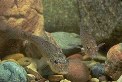
Duri punggung (Keseluruhan (total)) : 1 - 3; duri punggung lunak (Keseluruhan (total)) : 9 - 11; Duri dubur: 1; Sirip dubur lunak: 5 - 9; vertebrata, bertulang belakang: 33 - 36. Distinguished by the presence of an adipose fin; small weak spines in the dorsal and anal spines; rough ctenoid scales; and pectoral fins reaching well behind the bases of pelvic fins (Ref. 27547). Gill rakers short, stubby mounds with small teeth; lateral line nearly straight (Ref. 27547). Pale yellowish to silvery, often almost transparent; with a row of about 10 dark spots along midline of back, 10 or 11 spots along lateral line, and another row of spots high on sides above lateral line; fins transparent (Ref. 27547).
Body shape (shape guide): elongated.
Adults occur in lakes, deep flowing pools of creeks, and rivers (Ref. 5723). Usually found over sand (Ref. 5723). They move into the shallows of lakes at night to feed and moves back to deeper water as dawn approaches (Ref. 1998). They feed on insect larvae, amphipods and fishes (Ref. 1998). Important forage fish (Ref. 1998).
Spawning adults move inshore to shallow water or into shallow tributaries of lakes (Ref. 10348). Two or more males cluster with a single female near the surface. They press close to the female, often breaking the surface of the water, and eggs and milt are released (Ref. 27547). Some populations spawn exclusively at night (Ref. 10348), but others show no variation from daytime spawning (Ref. 10349). There is often, perhaps usually, heavy postspawning mortality (Ref. 27547).
Page, L.M. and B.M. Burr, 1991. A field guide to freshwater fishes of North America north of Mexico. Houghton Mifflin Company, Boston. 432 p. (Ref. 5723)
Status IUCN Red List (Ref. 130435: Version 2025-2 (Global))
ancaman kepada manusia
Harmless
penggunaan manusia
Perikanan: tidak ada kepentingan; Akuarium: Akuarium publik; umpan: occasionally
Alat, peralatan
laporan khas
muat turun XML
Sumber internet
Estimasi berdasarkan model
Indeks keanekaragaman filogenetik (Acuan
82804): PD
50 = 1.0002 [Uniqueness, from 0.5 = low to 2.0 = high].
Bayesian length-weight: a=0.00589 (0.00251 - 0.01382), b=3.12 (2.90 - 3.34), in cm total length, based on LWR estimates for this species & (Sub)family-body (Ref.
93245).
Tingkat Trofik (Acuan
69278): 3.4 ±0.51 se; based on food items.
Daya lenting (Acuan
120179): sedang, Waktu penggandaan populasi minimum 1.4 - 4.4 tahun (tm=2-3; tmax=4).
Kerentanan Penangkapan Ikan (Ref.
59153): Low to moderate vulnerability (30 of 100).
🛈