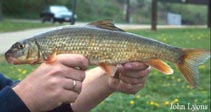
>
Cypriniformes (Carps) >
Catostomidae (Suckers) > Catostominae
Etymology: Moxostoma: Greek, myxo = to suckle + Greek, stoma = mouth (Ref. 45335); duquesnei: Named after Fort Duquesne, upper Ohio River drainage, Pittsburgh, Pennsylvania; type locality (Ref. 10294).
Eponymy: This is not a true eponym, but is named after Fort Duquesne (now Pittsburgh, Pennsylvania, USA) so actually a toponym. The fort was named after Marquis Duquesne, the governor-general of New France (i.e. the area of North America colonised by the French). (Ref. 128868), visit book page.
More on author: Lesueur.
Taxonomic Remarks
The original specific epithet is duquesnii but the unjustified emendation duquesnei is in current prevailing usage (see ECoF for nomenclatural details).
Environnement : milieu / zone climatique / profondeur / gamme de distribution
Écologie
; eau douce démersal; potamodrome (Ref. 126106). Temperate; 43°N - 32°N
North America: lower Great Lakes and Mississippi River basin from Ontario in Canada and from New York to southeastern Minnesota in USA and south to northern Alabama and eastern Oklahoma, USA; upper and middle Mobile Bay drainage in Georgia, Alabama and southeastern Tennessee in USA.
Taille / Poids / Âge
Maturité: Lm ? range ? - ? cm
Max length : 51.0 cm TL mâle / non sexé; (Ref. 5723); common length : 28.5 cm TL mâle / non sexé; (Ref. 12193); poids max. publié: 1.0 kg (Ref. 40637); âge max. reporté: 10 années (Ref. 12193)
Adults inhabit sand-bottomed to rock-bottomed pools and runs of creeks and small to medium rivers. Also found in impoundments (Ref. 5723, 10294). Adults feed on small benthic invertebrates, especially microcrustacea and midge larvae (Ref. 10294).
Cycle de vie et comportement reproducteur
Maturité | Reproduction | Frai | Œufs | Fécondité | Larves
Page, L.M. and B.M. Burr, 1991. A field guide to freshwater fishes of North America north of Mexico. Houghton Mifflin Company, Boston. 432 p. (Ref. 5723)
Statut dans la liste rouge de l'IUCN (Ref. 130435: Version 2025-2 (Global))
Menace pour l'homme
Harmless
Utilisations par l'homme
Pêche sportive: oui
Outils
Articles particuliers
Télécharger en XML
Sources Internet
Estimations basées sur des modèles
Indice de diversité phylogénétique (Réf.
82804): PD
50 = 0.5000 [Uniqueness, from 0.5 = low to 2.0 = high].
Bayesian length-weight: a=0.01023 (0.00754 - 0.01388), b=3.01 (2.95 - 3.07), in cm total length, based on LWR estimates for this species (Ref.
93245).
Niveau trophique (Réf.
69278): 3.0 ±0.41 se; based on food items.
Generation time: 2.8 ( na - na) years. Estimated as median ln(3)/K based on 1
growth studies.
Résilience (Réf.
120179): Milieu, temps minimum de doublement de population : 1,4 à 4,4 années (tmax=10).
Vulnérabilité de la pêche (Ref.
59153): Low to moderate vulnerability (32 of 100).
🛈