>
Cypriniformes (Carps) >
Leuciscidae (Minnows) > Leuciscinae
Etymology: Scardinius: A range of lofty mountains, Scardus, forming the boundary between Moesia and Macedonia.
More on author: Linnaeus.
Lingkungan: lingkungan / zona iklim / kisaran kedalaman / jangkauan distribusi
Ekologi
; air tawar; payau bentopelagis; pH range: 7.0 - 7.5; dH range: 10 - 15; potamodromous (Ref. 126106); kisaran kedalaman 0 - ? m. Temperate; 2°C - 22°C (Ref. 27368); 62°N - 36°N, 10°W - 70°E
Eurasia: Most European rivers north of Pyrenees and Alps, eastward to Ural and Eya drainages, Aral and White Sea basins; Black Sea basin in Europe and northern Asia Minor. Naturally absent from Iberian Peninsula, Adriatic basin, Italy, Greece south of Pinios drainage, Great Britain north of 54 N, Ireland and Scandinavia north of 62° N (Ref. 59043). Definitely absent in Siberia. Reports from this area arose from the confusion between the rudd and the roach (Ref. 1441). Introduced to several countries. Several countries report adverse ecological impact after introduction (Ref. 1739).
Panjang pada saat jatuh tempo pertama / Ukuran / Berat / umur
Kematangan: Lm 8.1 range ? - ? cm
Deprecated: number_format(): Passing null to parameter #1 ($num) of type float is deprecated in /var/www/html/includes/common.lib.php on line 1833
Max length : 61.7 cm TL (female); common length : 20.0 cm TL jantan/; (Ref. 556); Berat maksimum terpublikasi: 0.00 g; Umur maksimum dilaporkan: 19 Tahun (Ref. 27368)
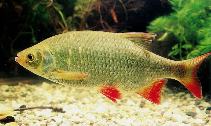
Duri punggung (Keseluruhan (total)) : 3; duri punggung lunak (Keseluruhan (total)) : 8 - 9; Duri dubur: 3; Sirip dubur lunak: 8 - 12; vertebrata, bertulang belakang: 36 - 39. Distinguished from its congeners in Europe by the following combination of characters: 39-42 scales along lateral line; anal fin with 10-13½ branched rays; 9-12 gill rakers; dorsal head profile straight or slightly convex, snout pointing forward, tip at or slightly above level of middle of eye; back not humped behind nape; eye bit close to dorsal head profile when viewed laterally; articulation of lower jaw in front of anterior margin of eye; head and body compressed, head width 13-14% SL; head length 24-28% SL; caudal peduncle depth 1.5-2.0 times in its length, 11-12% SL; and all fins with reddish hue, pelvic fin deep red (Ref. 59043).
Caudal fin with 18-19 rays (Ref. 2196)
Body shape (shape guide): fusiform / normal.
Adults occur mainly in nutrient-rich, well vegetated lowland rivers, backwaters, oxbows, ponds and lakes. They feed mainly on plankton, terrestrial insects and plant material. Breeding occurs on roots or submerged plants. They can adapt to unfavorable environmental condition (Ref. 59043). Colorless or pale yellow eggs are found attached to vegetation in shallow water (Ref. 41678). Consumed fresh (Ref. 30578). They are threatened due to the introduction of other species (Ref. 26100).
Males gather at spawning grounds and drive ripe females, often with much splashing, into dense vegetation to spawn (Ref. 59043). Eggs are very sticky (Ref. 59043) and colorless or pale yellow which are found attached to vegetation in shallow water (Ref. 41678).
Kottelat, M. and J. Freyhof, 2007. Handbook of European freshwater fishes. Publications Kottelat, Cornol and Freyhof, Berlin. 646 pp. (Ref. 59043)
Status IUCN Red List (Ref. 130435: Version 2025-2 (Global))
ancaman kepada manusia
Potential pest (Ref. 52336)
penggunaan manusia
Perikanan: nilai komersial kecil; Budidaya air: komersial; Ikan buruan: ya; Akuarium: Komersial; umpan: usually
Alat, peralatan
laporan khas
muat turun XML
Sumber internet
Estimasi berdasarkan model
Indeks keanekaragaman filogenetik (Acuan
82804): PD
50 = 0.5010 [Uniqueness, from 0.5 = low to 2.0 = high].
Bayesian length-weight: a=0.00776 (0.00712 - 0.00847), b=3.16 (3.13 - 3.19), in cm total length, based on LWR estimates for this species (Ref.
93245).
Tingkat Trofik (Acuan
69278): 2.5 ±0.2 se; based on diet studies.
Daya lenting (Acuan
120179): Rendah, Waktu penggandaan populasi minimum 4.5 - 14 tahun (K=0.09-0.18; tm=3-4; tmax=19).
Kerentanan Penangkapan Ikan (Ref.
59153): High to very high vulnerability (69 of 100).
🛈
Nutrisi (Ref.
124155): Calcium = 56.1 [27.8, 99.8] mg/100g; Iron = 0.484 [0.247, 0.976] mg/100g; Protein = 18 [16, 20] %; Omega3 = 0.606 [0.301, 1.230] g/100g; Selenium = 11.5 [5.7, 22.9] μg/100g; VitaminA = 26.1 [9.6, 75.8] μg/100g; Zinc = 0.65 [0.38, 1.47] mg/100g (wet weight); based on
nutrient studies.