>
Cypriniformes (Carps) >
Leuciscidae (Minnows) > Pogonichthyinae
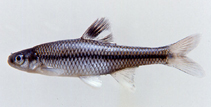
Etymology: Opsopoeodus: Greek, ops, = face, appearance + Greek, pous = foot + Greek, odous = teeth; emiliae: opsopoeodus, teeth for dainty feeding (Greek); and emiliae, named after Mrs. Emily Hay (wife of the author of the species, Dr. O. P. Hay) (Ref. 10294).
Eponymy: Mrs Mary Emily ‘Mollie’ Hay née Howsman (1849–1931) was the author’s wife. [...] (Ref. 128868), visit book page.
Entorno: milieu / zona climática / rango de profundidad / gama de distribución
Ecología
; agua dulce demersal. Subtropical; 45°N - 27°N
North America: Edisto River drainage in South Carolina to southern Florida and across Gulf Slope to Nueces River drainage in Texas, USA; north in Mississippi River and Great Lakes basins to southeastern Kansas, southeastern Minnesota, USA, and southern Ontario, Canada. The subspecies were previously recognized: Opsopoeodus emiliae peninsularis in peninsular Florida and Opsopoeodus emiliae emiliae in rest of range except where intergrades occur (southern Georgia and northeastern Florida west to Ochlockonee River).
Tamaño / Peso / Edad
Madurez: Lm ? range ? - ? cm
Max length : 6.6 cm TL macho / no sexado; (Ref. 10294)
Adults inhabit clear to turbid vegetated lakes, swamps, oxbows, sluggish streams of all sizes (Ref. 86798). They feed on insect larvae, filamentous algae and microcrustacea (Ref. 10294). Spawning occurs underneath flat rocks, in cavities; nest spawner (Ref. 79012). Migratory behaviour is undetermined (Ref. 126106).
Ciclo vital y comportamiento de apareamiento
Madurez | Reproducción | Puesta | Huevos | Fecundidad | Larva
Page, L.M. and B.M. Burr, 2011. A field guide to freshwater fishes of North America north of Mexico. Boston : Houghton Mifflin Harcourt, 663p. (Ref. 86798)
Situación en la Lista Roja de la UICN (Ref. 130435: Version 2025-2 (Global))
Amenaza para el ser humano
Harmless
Usos humanos
Herramientas
Informes especiales
Descargar XML
Fuentes de Internet
Estimaciones basadas en modelos
Índice de diversidad filogenética (Referencia
82804): PD
50 = 1.0000 [Uniqueness, from 0.5 = low to 2.0 = high].
Bayesian length-weight: a=0.00537 (0.00266 - 0.01086), b=3.10 (2.92 - 3.28), in cm total length, based on LWR estimates for this (Sub)family-body shape (Ref.
93245).
Nivel trófico (Referencia
69278): 2.9 ±0.35 se; based on food items.
Resiliencia (Referencia
120179): Alto, población duplicada en un tiempo mínimo inferior a 15 meses (Preliminary K or Fecundity.).
Vulnerabilidad pesquera (Ref.
59153): Low vulnerability (10 of 100).
🛈