>
Cypriniformes (Carps) >
Leuciscidae (Minnows) > Pogonichthyinae
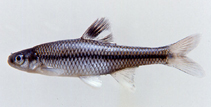
Etymology: Opsopoeodus: Greek, ops, = face, appearance + Greek, pous = foot + Greek, odous = teeth; emiliae: opsopoeodus, teeth for dainty feeding (Greek); and emiliae, named after Mrs. Emily Hay (wife of the author of the species, Dr. O. P. Hay) (Ref. 10294).
Eponymy: Mrs Mary Emily ‘Mollie’ Hay née Howsman (1849–1931) was the author’s wife. [...] (Ref. 128868), visit book page.
Environnement : milieu / zone climatique / profondeur / gamme de distribution
Écologie
; eau douce démersal. Subtropical; 45°N - 27°N
North America: Edisto River drainage in South Carolina to southern Florida and across Gulf Slope to Nueces River drainage in Texas, USA; north in Mississippi River and Great Lakes basins to southeastern Kansas, southeastern Minnesota, USA, and southern Ontario, Canada. The subspecies were previously recognized: Opsopoeodus emiliae peninsularis in peninsular Florida and Opsopoeodus emiliae emiliae in rest of range except where intergrades occur (southern Georgia and northeastern Florida west to Ochlockonee River).
Taille / Poids / Âge
Maturité: Lm ? range ? - ? cm
Max length : 6.6 cm TL mâle / non sexé; (Ref. 10294)
Adults inhabit clear to turbid vegetated lakes, swamps, oxbows, sluggish streams of all sizes (Ref. 86798). They feed on insect larvae, filamentous algae and microcrustacea (Ref. 10294). Spawning occurs underneath flat rocks, in cavities; nest spawner (Ref. 79012). Migratory behaviour is undetermined (Ref. 126106).
Cycle de vie et comportement reproducteur
Maturité | Reproduction | Frai | Œufs | Fécondité | Larves
Page, L.M. and B.M. Burr, 2011. A field guide to freshwater fishes of North America north of Mexico. Boston : Houghton Mifflin Harcourt, 663p. (Ref. 86798)
Statut dans la liste rouge de l'IUCN (Ref. 130435: Version 2025-2 (Global))
Menace pour l'homme
Harmless
Utilisations par l'homme
Outils
Articles particuliers
Télécharger en XML
Sources Internet
Estimations basées sur des modèles
Indice de diversité phylogénétique (Réf.
82804): PD
50 = 1.0000 [Uniqueness, from 0.5 = low to 2.0 = high].
Bayesian length-weight: a=0.00537 (0.00266 - 0.01086), b=3.10 (2.92 - 3.28), in cm total length, based on LWR estimates for this (Sub)family-body shape (Ref.
93245).
Niveau trophique (Réf.
69278): 2.9 ±0.35 se; based on food items.
Résilience (Réf.
120179): Haut, temps minimum de doublement de population inférieur à 15 mois (Preliminary K or Fecundity.).
Vulnérabilité de la pêche (Ref.
59153): Low vulnerability (10 of 100).
🛈