Ambiente: milieu / zona climática / intervalo de profundidade / gama de distribuição
Ecologia
; Água doce bentopelágico; pH range: 6.5 - 7.0; dH range: 5 - 8; potamódromo (Ref. 51243); intervalo de profundidade 5 - ? m (Ref. 27732). Tropical; 22°C - 26°C (Ref. 2059); 20°N - 3°N
Asia: Mekong and Chao Phraya basins, Malay Peninsula, Sumatra, Java and Borneo (Ref. 27732). Reported from Salween and Maeklong basins (Ref. 26336); China (Ref. 9671); and lower Myanmar (Ref. 4832).
Comprimento na primeira maturidade / Tamanho / Peso / Idade
Maturidade: Lm 19.2, range 18 - 20.235 cm
Max length : 32.0 cm SL macho/indeterminado; (Ref. 7050); common length : 20.0 cm SL macho/indeterminado; (Ref. 2686)
Descrição breve
Chaves de identificação | Morfologia | Morfometria
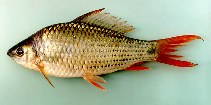
Raios dorsais moles (total) : 17 - 19; Raios anais moles: 8. Distinguished from the other species of the genus in having 12-18 branched dorsal rays; 6-9 rows of spots along scale rows (not always distinct), and a large round blotch on the caudal peduncle (Ref. 27732). No black midlateral stripe; sometimes with a spot above a pectoral fin (Ref. 12693).
Body shape (shape guide): fusiform / normal.
Adults occur in all type of habitats, but usually associated with large streams with slow current and muddy to sandy substrate (Ref. 27732). They migrate from river to flooded areas during the onset of the flood season and returns to river habitats at the end of that period (Ref. 37770). Juveniles are usually seen first in August, they move back to permanent water as flooded lands dry up. Back in the rivers they are attached to brush piles, tree roots and other solid objects (Ref. 12693). Adults feed on roots of plants (Hydrilla verticillata), unicellular algae and some crustaceans. Most abundant fish in Nam Ngum reservoir where it is captured with large dip nets set on rafts. Good flesh but bony and used for lap pa or grilled (Ref. 6459). Marketed fresh or used to make prahoc (Ref. 12693).
Tan, H.H. and M. Kottelat, 2009. The fishes of Batang Hari drainage, Sumatra, with descriptions of six new species. Ichthyol. Explor. Freshwat. 20(1):13-69. (Ref. 81211)
Categoria na Lista Vermelha da IUCN (Ref. 130435: Version 2025-2 (Global))
Ameaça para o homem
Harmless
Utilização humana
Pescarias: altamente comercial; Aquacultura: espécies comerciais; Aquário: Aquários públicos
Ferramentas
Relatórios especiais
Descarregue XML
Fontes da internet
Estimativas baseadas em modelos
Índice de diversidade filogenética (Ref.
82804): PD
50 = 0.5000 [Uniqueness, from 0.5 = low to 2.0 = high].
Bayesian length-weight: a=0.01023 (0.00785 - 0.01334), b=3.05 (3.01 - 3.09), in cm total length, based on LWR estimates for this species (Ref.
93245).
Nível Trófico (Ref.
69278): 2.6 ±0.0 se; based on diet studies.
Generation time: 3.4 ( na - na) years. Estimated as median ln(3)/K based on 1
growth studies.
Resiliência (Ref.
120179): Elevada, tempo mínimo de duplicação da população menor que 15 meses (K=0.32-1.15; Fec=30,000-300,000).
Vulnerabilidade da pesca (Ref.
59153): Low to moderate vulnerability (34 of 100).
🛈
Nutrientes (Ref.
124155): Calcium = 558 [160, 1,378] mg/100g; Iron = 1.4 [0.6, 3.9] mg/100g; Protein = 17.9 [16.4, 19.4] %; Omega3 = 0.365 [0.163, 0.878] g/100g; Selenium = 42.4 [18.7, 89.8] μg/100g; VitaminA = 53.5 [22.4, 127.9] μg/100g; Zinc = 1.94 [1.11, 4.18] mg/100g (wet weight); based on
nutrient studies.