Classificazione / Nomi
Nomi Comuni | Sinonimi | Catalog of Fishes(Genere, Specie) | ITIS | CoL | WoRMS | Cloffa
Ambiente: milieu / zona climatica / distribuzione batimetrica / gamma di distribuzione
Ecologia
; acqua dolce benthopelagico; pH range: 6.5 - 7.0; dH range: 5 - 8; potamodromo (Ref. 51243); distribuzione batimetrica 5 - ? m (Ref. 27732). Tropical; 22°C - 26°C (Ref. 2059); 20°N - 3°N
Asia: Mekong and Chao Phraya basins, Malay Peninsula, Sumatra, Java and Borneo (Ref. 27732). Reported from Salween and Maeklong basins (Ref. 26336); China (Ref. 9671); and lower Myanmar (Ref. 4832).
Lunghezza alla prima maturità / Dimensione / Peso / Età
Maturità: Lm 19.2, range 18 - 20.235 cm
Max length : 32.0 cm SL maschio/sesso non determinato; (Ref. 7050); common length : 20.0 cm SL maschio/sesso non determinato; (Ref. 2686)
Breve descrizione
Chiavi di identificazione | Morfologia | Morfometria
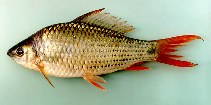
Raggi dorsali molli (totale) : 17 - 19; Raggi anali molli: 8. Distinguished from the other species of the genus in having 12-18 branched dorsal rays; 6-9 rows of spots along scale rows (not always distinct), and a large round blotch on the caudal peduncle (Ref. 27732). No black midlateral stripe; sometimes with a spot above a pectoral fin (Ref. 12693).
Body shape (shape guide): fusiform / normal.
Adults occur in all type of habitats, but usually associated with large streams with slow current and muddy to sandy substrate (Ref. 27732). They migrate from river to flooded areas during the onset of the flood season and returns to river habitats at the end of that period (Ref. 37770). Juveniles are usually seen first in August, they move back to permanent water as flooded lands dry up. Back in the rivers they are attached to brush piles, tree roots and other solid objects (Ref. 12693). Adults feed on roots of plants (Hydrilla verticillata), unicellular algae and some crustaceans. Most abundant fish in Nam Ngum reservoir where it is captured with large dip nets set on rafts. Good flesh but bony and used for lap pa or grilled (Ref. 6459). Marketed fresh or used to make prahoc (Ref. 12693).
Tan, H.H. and M. Kottelat, 2009. The fishes of Batang Hari drainage, Sumatra, with descriptions of six new species. Ichthyol. Explor. Freshwat. 20(1):13-69. (Ref. 81211)
Stato della Lista Rossa IUCN (Ref. 130435: Version 2025-2 (Global))
Minaccia per l'uomo
Harmless
Usi umani
Pesca: elevato interesse commerciale; Acquacoltura: commerciale; Acquario: Acquari pubblici
Strumenti
Rapporti speciali
Scarica XML
Fonti Internet
Stime basate su modelli
Indice di diversità filogenetica (Fonte Biblio.
82804): PD
50 = 0.5000 [Uniqueness, from 0.5 = low to 2.0 = high].
Bayesian length-weight: a=0.01023 (0.00785 - 0.01334), b=3.05 (3.01 - 3.09), in cm total length, based on LWR estimates for this species (Ref.
93245).
Livello trofico (Fonte Biblio.
69278): 2.6 ±0.0 se; based on diet studies.
Generation time: 3.4 ( na - na) years. Estimated as median ln(3)/K based on 1
growth studies.
Resilienza (Fonte Biblio.
120179): Alto, tempo minimo di raddoppiamento della popolazione meno di 15 mesi (K=0.32-1.15; Fec=30,000-300,000).
Vulnerabilità della pesca (Ref.
59153): Low to moderate vulnerability (34 of 100).
🛈
Nutrienti (Ref.
124155): Calcium = 558 [160, 1,378] mg/100g; Iron = 1.4 [0.6, 3.9] mg/100g; Protein = 17.9 [16.4, 19.4] %; Omega3 = 0.365 [0.163, 0.878] g/100g; Selenium = 42.4 [18.7, 89.8] μg/100g; VitaminA = 53.5 [22.4, 127.9] μg/100g; Zinc = 1.94 [1.11, 4.18] mg/100g (wet weight); based on
nutrient studies.