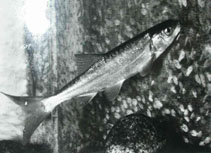
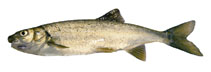
Classification / Noms
Noms communs | Synonymes | Catalog of Fishes(Genre, Espèce) | ITIS | CoL | WoRMS | Cloffa
>
Cypriniformes (Carps) >
Leuciscidae (Minnows) > Laviniinae
Etymology: Gila: A river flowing from Southwest New Mexico westward across south Arizona into the Colorado River; alutacea: The specific name is derived from alutaceus (leathery) (Ref. 1998).
More on authors: Agassiz & Pickering.
Environnement : milieu / zone climatique / profondeur / gamme de distribution
Écologie
; eau douce démersal; potamodrome (Ref. 126106). Temperate; 55°N - 41°N
North America: Fraser and Columbia River drainages in British Columbia in Canada, Washington, Idaho, Oregon, and Nevada in USA; Harney River basin in Oregon, USA.
Taille / Poids / Âge
Maturité: Lm ? range ? - ? cm
Max length : 30.0 cm TL mâle / non sexé; (Ref. 86798); common length : 17.5 cm TL mâle / non sexé; (Ref. 12193)
Rayons mous dorsaux (Total) : 10 - 11; Rayons mous anaux: 9 - 10. Moderately compressed body, deepest in front of dorsal fin; strong tapering to narrow caudal peduncle; large, forked caudal fin; wide head; subterminal mouth; hard plate on lower jaw; large eye; dorsal-fin origin over pelvic-fin origin; rounded, protruding snout; decurved, complete lateral line with 85-93 scales; long intestine (at least twice length of body) ; black peritoneum; dorsal fin with 10-11 rays; anal fin with 9-10 rays; pharyngeal teeth 0,4-4,0 to 0,5-5,0; gray above, brassy silver side; yellow to brown fins; large individuals with gray dorsal and caudal fins, orange at pectoral and pelvic-fin bases (Ref. 86798). Tail large and flaring. Lower jaw bears a sharp edge, nearly square when viewed from beneath. Sharp part of lip consist of cornified epithelium which is sometimes slightly calcified. Internal to the fleshy upper lip is a small, hard plate upon which the lower lip bears. Young fish have a more rounded lower lip, when viewed either laterally or from below. Digestive tract in adults is about twice the length of the body, with most of its length consisting of a coiled section posterior to the entry of the bile duct (Ref. 52680).
Body shape (shape guide): fusiform / normal.
Adults occur in flowing pools and runs over sand and gravel in creeks and small to medium rivers; also in margins of lakes (Ref. 86798). Adults feed mainly on diatoms, also on filamentous algae; young feed on surface insects (Ref. 1998).
Cycle de vie et comportement reproducteur
Maturité | Reproduction | Frai | Œufs | Fécondité | Larves
Page, L.M. and B.M. Burr, 2011. A field guide to freshwater fishes of North America north of Mexico. Boston : Houghton Mifflin Harcourt, 663p. (Ref. 86798)
Statut dans la liste rouge de l'IUCN (Ref. 130435: Version 2025-2 (Global))
Menace pour l'homme
Harmless
Utilisations par l'homme
Pêcheries: intérêt commercial mineur
Outils
Articles particuliers
Télécharger en XML
Sources Internet
Estimations basées sur des modèles
Indice de diversité phylogénétique (Réf.
82804): PD
50 = 0.5000 [Uniqueness, from 0.5 = low to 2.0 = high].
Bayesian length-weight: a=0.01148 (0.00451 - 0.02922), b=3.03 (2.81 - 3.25), in cm total length, based on LWR estimates for this (Sub)family-body shape (Ref.
93245).
Niveau trophique (Réf.
69278): 2.1 ±0.0 se; based on diet studies.
Résilience (Réf.
120179): Milieu, temps minimum de doublement de population : 1,4 à 4,4 années (tm=3-4).
Vulnérabilité de la pêche (Ref.
59153): Low vulnerability (20 of 100).
🛈