>
Blenniiformes (Blennies) >
Blenniidae (Combtooth blennies) > Salariinae
Etymology: Ecsenius: Greek, exenios, -os, -on = uncontrolled, immoderate.
Eponymy: Norman S Portenoy of Bethesda, Maryland, was honoured for his many years of support of ichthyological exploration by the staff of the Smithsonian Institution. (Ref. 128868), visit book page.
Entorno: milieu / zona climática / rango de profundidad / gama de distribución
Ecología
marino demersal; rango de profundidad 0 - 14 m (Ref. 5296). Tropical
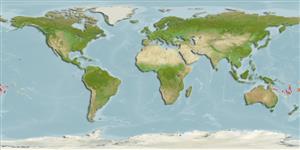
Western Central Pacific: Rotuma (Fiji) and Tutuila, American Samoa.
Tamaño / Peso / Edad
Madurez: Lm ? range ? - ? cm
Max length : 4.5 cm SL macho / no sexado; (Ref. 5296)
Descripción breve
Claves de identificación | Morfología | Morfometría
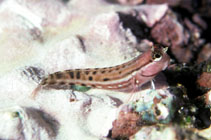
Espinas dorsales (total) : 12; Radios blandos dorsales (total) : 13 - 15; Espinas anales: 2; Radios blandos anales: 14 - 16; Vértebra: 31 - 34. Dorsal fin XII,13-15 (usually 14), spinous and segmented-ray with deep notch in-between. Anal fin II,14-16 (typically 16). Pectoral fin 12 or 13 (typically 13). Segmented caudal-fin rays 13. Vertebrae 10 + 21-24 (typically 23). Dentary incisor teeth 48-57 which includes anterior canine teeth very similar in appearance with incisors; posterior canines 0 or 1 on each side (rarely 0). Lateral line lacking vertical pairs of pores, terminating posteriorly at point between vertical from interspace between dorsal-fin spines 10 and 11 and vertical from spine 12 (rarely anterior to spine 11). With cirrus on posterior rim of anterior nostril; absent on anterior rim. Dorsal row of dark spots below segmented-ray portion of dorsal fin usually saddle-like; space between pair of dorsal dark body spots just posterior to vertical from anteriormost (of 3) dark spot of ventral row narrower than space between second spot of pair and next spot posteriorly; slender, pale stripe extending most of midbody length usually present; dark spots on posterior half of body often not surrounded by conspicuous, discrete, pale rings (diffuse or faintly pale rings often
present around spots) (Ref. 5296).
Body shape (shape guide): elongated; Cross section: oval.
Specimens collected from the ocean side of reef crest with rock and dead coral and some live coral (Ref. 5296). Oviparous. Eggs are demersal and adhesive (Ref. 205), and are attached to the substrate via a filamentous, adhesive pad or pedestal (Ref. 94114). Larvae are planktonic, often found in shallow, coastal waters (Ref. 94114).
Ciclo vital y comportamiento de apareamiento
Madurez | Reproducción | Puesta | Huevos | Fecundidad | Larva
Oviparous, distinct pairing (Ref. 205).
Springer, V.G., 1988. The Indo-Pacific blenniid fish genus Ecsenius. Smithson. Contrib. Zool. (465):134 p. (Ref. 5296)
Situación en la Lista Roja de la UICN (Ref. 130435: Version 2025-2 (Global))
Amenaza para el ser humano
Harmless
Usos humanos
Herramientas
Informes especiales
Descargar XML
Fuentes de Internet
Estimaciones basadas en modelos
Temperatura preferida (Referencia
123201): 24.9 - 29.5, mean 27.9 °C (based on 476 cells).
Índice de diversidad filogenética (Referencia
82804): PD
50 = 0.5000 [Uniqueness, from 0.5 = low to 2.0 = high].
Bayesian length-weight: a=0.00776 (0.00354 - 0.01702), b=3.00 (2.81 - 3.19), in cm total length, based on LWR estimates for this (Sub)family-body shape (Ref.
93245).
Nivel trófico (Referencia
69278): 2.0 ±0.00 se; based on food items.
Resiliencia (Referencia
120179): Alto, población duplicada en un tiempo mínimo inferior a 15 meses (Preliminary K or Fecundity.).
Vulnerabilidad pesquera (Ref.
59153): Low vulnerability (10 of 100).
🛈