>
Blenniiformes (Blennies) >
Blenniidae (Combtooth blennies) > Salariinae
Etymology: Ecsenius: Greek, exenios, -os, -on = uncontrolled, immoderate.
Eponymy: Norman S Portenoy of Bethesda, Maryland, was honoured for his many years of support of ichthyological exploration by the staff of the Smithsonian Institution. (Ref. 128868), visit book page.
Ambiente: milieu / zona climatica / distribuzione batimetrica / gamma di distribuzione
Ecologia
marino demersale; distribuzione batimetrica 0 - 14 m (Ref. 5296). Tropical
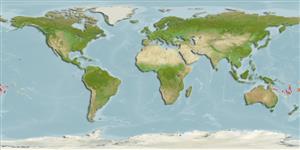
Western Central Pacific: Rotuma (Fiji) and Tutuila, American Samoa.
Dimensione / Peso / Età
Maturità: Lm ? range ? - ? cm
Max length : 4.5 cm SL maschio/sesso non determinato; (Ref. 5296)
Breve descrizione
Chiavi di identificazione | Morfologia | Morfometria
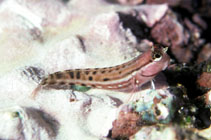
Spine dorsali (totale) : 12; Raggi dorsali molli (totale) : 13 - 15; Spine anali: 2; Raggi anali molli: 14 - 16; Vertebre: 31 - 34. Dorsal fin XII,13-15 (usually 14), spinous and segmented-ray with deep notch in-between. Anal fin II,14-16 (typically 16). Pectoral fin 12 or 13 (typically 13). Segmented caudal-fin rays 13. Vertebrae 10 + 21-24 (typically 23). Dentary incisor teeth 48-57 which includes anterior canine teeth very similar in appearance with incisors; posterior canines 0 or 1 on each side (rarely 0). Lateral line lacking vertical pairs of pores, terminating posteriorly at point between vertical from interspace between dorsal-fin spines 10 and 11 and vertical from spine 12 (rarely anterior to spine 11). With cirrus on posterior rim of anterior nostril; absent on anterior rim. Dorsal row of dark spots below segmented-ray portion of dorsal fin usually saddle-like; space between pair of dorsal dark body spots just posterior to vertical from anteriormost (of 3) dark spot of ventral row narrower than space between second spot of pair and next spot posteriorly; slender, pale stripe extending most of midbody length usually present; dark spots on posterior half of body often not surrounded by conspicuous, discrete, pale rings (diffuse or faintly pale rings often
present around spots) (Ref. 5296).
Body shape (shape guide): elongated; Cross section: oval.
Specimens collected from the ocean side of reef crest with rock and dead coral and some live coral (Ref. 5296). Oviparous. Eggs are demersal and adhesive (Ref. 205), and are attached to the substrate via a filamentous, adhesive pad or pedestal (Ref. 94114). Larvae are planktonic, often found in shallow, coastal waters (Ref. 94114).
Ciclo vitale e comportamento di accoppiamento
Maturità | Riproduzione | Deposizione | Uova | Fecondità | Larve
Oviparous, distinct pairing (Ref. 205).
Springer, V.G., 1988. The Indo-Pacific blenniid fish genus Ecsenius. Smithson. Contrib. Zool. (465):134 p. (Ref. 5296)
Stato della Lista Rossa IUCN (Ref. 130435: Version 2025-2 (Global))
Minaccia per l'uomo
Harmless
Usi umani
Strumenti
Rapporti speciali
Scarica XML
Fonti Internet
Stime basate su modelli
Temperatura preferita (Fonte Biblio.
123201): 24.9 - 29.5, mean 27.9 °C (based on 476 cells).
Indice di diversità filogenetica (Fonte Biblio.
82804): PD
50 = 0.5000 [Uniqueness, from 0.5 = low to 2.0 = high].
Bayesian length-weight: a=0.00776 (0.00354 - 0.01702), b=3.00 (2.81 - 3.19), in cm total length, based on LWR estimates for this (Sub)family-body shape (Ref.
93245).
Livello trofico (Fonte Biblio.
69278): 2.0 ±0.00 se; based on food items.
Resilienza (Fonte Biblio.
120179): Alto, tempo minimo di raddoppiamento della popolazione meno di 15 mesi (Preliminary K or Fecundity.).
Vulnerabilità della pesca (Ref.
59153): Low vulnerability (10 of 100).
🛈