>
Blenniiformes (Blennies) >
Blenniidae (Combtooth blennies) > Salariinae
Etymology: Blenniella: Diminutive of blennius, Greek,blenios = mucus (Ref. 45335).
More on author: Bleeker.
Ambiente: milieu / zona climática / intervalo de profundidade / gama de distribuição
Ecologia
marinhas associadas(os) a recifes; intervalo de profundidade 0 - 2 m (Ref. 90102), usually 0 - 1 m (Ref. 9962). Tropical
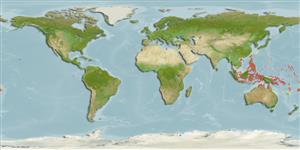
Western Pacific: Taiwan to Indonesia and Efate, New Hebrides (Vanuatu).
Tamanho / Peso / Idade
Maturidade: Lm ? range ? - ? cm
Max length : 6.0 cm SL macho/indeterminado; (Ref. 9962); 5.1 cm SL (female)
Descrição breve
Chaves de identificação | Morfologia | Morfometria
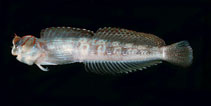
Espinhos dorsais (total) : 12 - 14; Raios dorsais moles (total) : 18 - 21; Espinhos anais: 2; Raios anais moles: 19 - 22; Vértebras: 37 - 40. Dorsal fin XII-XIV, 18-21, notched between spinous and segmented-ray portions; anal fin II, 19-22; pectoral rays 12-15; pelvic fin I, 3. Vertebrae 11-12 + 26-28. Orbital cirrus simple filamentous; nasal cirri short and simple to palmate with 2-6 branches; nape with cirri. Lateral line, continuous anterodorsally below dorsal spines from 4th to 10th, disconnected posteroventrally up to below dorsal spine 7-8th to 12-13th. Mandibular pores 4-6 Lips margin entire. Occipital crest present only in males, and only 0.7 mm or lower. Meristic characters slightly vary geographically, increasing from north to south (Ref. 9962). Body depth at anal-fin origin 5.3-6.0 in SL. Male grey to dark brown with longitudinal rows of blue dashes. Female pale grey with dark horizontal dashes and vertical dark A/H-shaped bars; dorsal and caudal fins spotted (Ref. 90102).
Body shape (shape guide): elongated.
Found solitary or groups (Ref. 90102) near-shore rocky areas, including tide pools and at depths usually less than 1 meter (Ref. 9962). Oviparous. Eggs are demersal and adhesive (Ref. 205), and are attached to the substrate via a filamentous, adhesive pad or pedestal (Ref. 94114). Larvae are planktonic, often found in shallow, coastal waters (Ref. 94114).
Ciclo de vida e comportamento de acasalamento
Maturidade | Reprodução | Desova | Ovos | Fecundidade | Larvas
Distinct pairing (Ref. 205).
Springer, V.G. and J.T. Williams, 1994. The Indo-West Pacific blenniid fish genus Istiblennius reappraised: a revision of Istiblennius, Blenniella, and Paralticus, new genus. Smithson. Contrib. Zool. 565:1-193. (Ref. 9962)
Categoria na Lista Vermelha da IUCN (Ref. 130435: Version 2025-2 (Global))
Ameaça para o homem
Harmless
Utilização humana
Ferramentas
Relatórios especiais
Descarregue XML
Fontes da internet
Estimativas baseadas em modelos
Temperatura preferida (Ref.
123201): 27.4 - 29.4, mean 28.8 °C (based on 963 cells).
Índice de diversidade filogenética (Ref.
82804): PD
50 = 0.5020 [Uniqueness, from 0.5 = low to 2.0 = high].
Bayesian length-weight: a=0.00776 (0.00354 - 0.01702), b=3.00 (2.81 - 3.19), in cm total length, based on LWR estimates for this (Sub)family-body shape (Ref.
93245).
Nível Trófico (Ref.
69278): 2.9 ±0.3 se; based on size and trophs of closest relatives
Resiliência (Ref.
120179): Elevada, tempo mínimo de duplicação da população menor que 15 meses (Preliminary K or Fecundity.).
Vulnerabilidade da pesca (Ref.
59153): Low vulnerability (10 of 100).
🛈
Nutrientes (Ref.
124155): Calcium = 243 [110, 478] mg/100g; Iron = 1.02 [0.53, 1.93] mg/100g; Protein = 17.9 [16.5, 19.1] %; Omega3 = 0.0718 [, ] g/100g; Selenium = 15.3 [6.4, 39.0] μg/100g; VitaminA = 143 [33, 641] μg/100g; Zinc = 3.4 [2.1, 5.3] mg/100g (wet weight);