>
Blenniiformes (Blennies) >
Blenniidae (Combtooth blennies) > Salariinae
Etymology: Blenniella: Diminutive of blennius, Greek,blenios = mucus (Ref. 45335).
More on author: Bleeker.
Environnement : milieu / zone climatique / profondeur / gamme de distribution
Écologie
marin récifal; profondeur 0 - 2 m (Ref. 90102), usually 0 - 1 m (Ref. 9962). Tropical
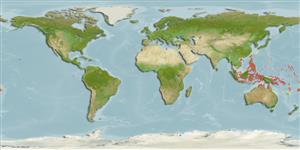
Western Pacific: Taiwan to Indonesia and Efate, New Hebrides (Vanuatu).
Taille / Poids / Âge
Maturité: Lm ? range ? - ? cm
Max length : 6.0 cm SL mâle / non sexé; (Ref. 9962); 5.1 cm SL (female)
Description synthétique
Clés d'identification | Morphologie | Morphométrie
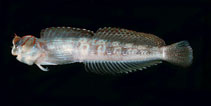
Épines dorsales (Total) : 12 - 14; Rayons mous dorsaux (Total) : 18 - 21; Épines anales: 2; Rayons mous anaux: 19 - 22; Vertèbres: 37 - 40. Dorsal fin XII-XIV, 18-21, notched between spinous and segmented-ray portions; anal fin II, 19-22; pectoral rays 12-15; pelvic fin I, 3. Vertebrae 11-12 + 26-28. Orbital cirrus simple filamentous; nasal cirri short and simple to palmate with 2-6 branches; nape with cirri. Lateral line, continuous anterodorsally below dorsal spines from 4th to 10th, disconnected posteroventrally up to below dorsal spine 7-8th to 12-13th. Mandibular pores 4-6 Lips margin entire. Occipital crest present only in males, and only 0.7 mm or lower. Meristic characters slightly vary geographically, increasing from north to south (Ref. 9962). Body depth at anal-fin origin 5.3-6.0 in SL. Male grey to dark brown with longitudinal rows of blue dashes. Female pale grey with dark horizontal dashes and vertical dark A/H-shaped bars; dorsal and caudal fins spotted (Ref. 90102).
Body shape (shape guide): elongated.
Found solitary or groups (Ref. 90102) near-shore rocky areas, including tide pools and at depths usually less than 1 meter (Ref. 9962). Oviparous. Eggs are demersal and adhesive (Ref. 205), and are attached to the substrate via a filamentous, adhesive pad or pedestal (Ref. 94114). Larvae are planktonic, often found in shallow, coastal waters (Ref. 94114).
Cycle de vie et comportement reproducteur
Maturité | Reproduction | Frai | Œufs | Fécondité | Larves
Distinct pairing (Ref. 205).
Springer, V.G. and J.T. Williams, 1994. The Indo-West Pacific blenniid fish genus Istiblennius reappraised: a revision of Istiblennius, Blenniella, and Paralticus, new genus. Smithson. Contrib. Zool. 565:1-193. (Ref. 9962)
Statut dans la liste rouge de l'IUCN (Ref. 130435: Version 2025-2 (Global))
Menace pour l'homme
Harmless
Utilisations par l'homme
Outils
Articles particuliers
Télécharger en XML
Sources Internet
Estimations basées sur des modèles
Température préférée (Réf.
123201): 27.4 - 29.4, mean 28.8 °C (based on 963 cells).
Indice de diversité phylogénétique (Réf.
82804): PD
50 = 0.5020 [Uniqueness, from 0.5 = low to 2.0 = high].
Bayesian length-weight: a=0.00776 (0.00354 - 0.01702), b=3.00 (2.81 - 3.19), in cm total length, based on LWR estimates for this (Sub)family-body shape (Ref.
93245).
Niveau trophique (Réf.
69278): 2.9 ±0.3 se; based on size and trophs of closest relatives
Résilience (Réf.
120179): Haut, temps minimum de doublement de population inférieur à 15 mois (Preliminary K or Fecundity.).
Vulnérabilité de la pêche (Ref.
59153): Low vulnerability (10 of 100).
🛈
Nutriments (Ref.
124155): Calcium = 243 [110, 478] mg/100g; Iron = 1.02 [0.53, 1.93] mg/100g; Protein = 17.9 [16.5, 19.1] %; Omega3 = 0.0718 [, ] g/100g; Selenium = 15.3 [6.4, 39.0] μg/100g; VitaminA = 143 [33, 641] μg/100g; Zinc = 3.4 [2.1, 5.3] mg/100g (wet weight);