>
Salmoniformes (Salmons) >
Salmonidae (Salmonids) > Coregoninae
Etymology: Coregonus: Greek, kore = pupils of the eye + Greek, gonia = angle (Ref. 45335); nasus: nasus refering to shape of nose (Ref. 1998).
More on author: Pallas.
Môi trường: môi trường / vùng khí hậu / Mức độ sâu / phạm vi phân phối
Sinh thái học
; nước ngọt; thuộc về nước lợ pelagic-neritic; di cư biển sông (để đẻ trứng) (Ref. 138280). Polar; 73°N - 59°N, 46°E - 102°W
Eurasia and North America: all drainages of Arctic Ocean from Volonga and Pechora to Alaska.
Chiều dài lúc trưởng thành đầu tiên / Bộ gần gũi / Khối lượng (Trọng lượng) / Tuổi
Chín muồi sinh dục: Lm ? range ? - ? cm
Max length : 71.0 cm TL con đực/không giới tính; (Ref. 96339); common length : 46.0 cm TL con đực/không giới tính; (Ref. 1998); Khối lượng cực đại được công bố: 16.0 kg (Ref. 1998); Tuổi cực đại được báo cáo: 15 các năm (Ref. 59043)
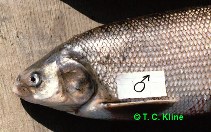
Các tia vây lưng cứng (tổng cộng) : 0; Các vây lưng mềm (tổng cộng) : 10 - 13; Tia cứng vây hậu môn: 0; Tia mềm vây hậu môn: 11 - 14; Động vật có xương sống: 60 - 65. Distinguished by its short gill rakers, which are less than one-fifth as long as the interorbital width, and the rounded to flat profile of the head (Ref. 27547). Adipose fin fairly large; axillary process present in the pelvic fins (Ref. 27547). Olive-brown to nearly black on back; sides silvery, often with a gray cast; belly white to yellowish; fins usually rather gray in adults, pale in young (Ref. 27547).
Body shape (shape guide): fusiform / normal.
Nerito-pelagic (Ref. 58426). Adults are found in lowland river and lakes (Ref. 59043) but most frequently in streams (Ref. 5723). Lacustrine and estuarine anadromous forms exist (Ref. 593). Alevins and juveniles feed on zooplankton, adults on benthos, mainly chironomid larvae and molluscs (Ref. 1998, 59043). Males reproduce for the first time in 4-8 years, females at 5-9. Adults start upstream migration in late July - August and reach spawning sites by October - November and spawn in stretches with swift current and sand-pebble bottom, often under ice. Spawning lasts 5-7 days and fish leave spawning site soon after, migrating downstream to overwinter in deeper places of lower stretches of rivers together with older juveniles. In spring, alevins drift from spawning sites downstream with flood-water and forage in floodplain lakes and oxbows where they remain until end of summer before moving to river or reaching maturity (if lakes are large enough and do not dry out). Widely used for aquaculture in eastern Europe (Ref. 59043). Flesh is highly esteemed (Ref. 1998). Sold fresh, dried, or smoked (Ref. 1998).
Mature adults make upstream spawning migrations beginning as early as June and may extend to September or later (Ref. 28214, 28852, 28855, 28857) and move back downstream after spawning and overwinter in deep parts of the rivers or in estuaries (Ref. 27547). Young hatch in the spring and move downward (Ref. 27547).
Robins, C.R., R.M. Bailey, C.E. Bond, J.R. Brooker, E.A. Lachner, R.N. Lea and W.B. Scott, 1991. Common and scientific names of fishes from the United States and Canada. Am. Fish. Soc. Spec. Publ. (20):183 p. (Ref. 3814)
Tình trạng Sách đỏ IUCN (Ref. 130435: Version 2025-2 (Global))
Mối đe dọa đối với con người
Harmless
Sử dụng của con người
Các nghề cá: tính thương mại; cá để chơi: đúng
Các công cụ
Báo cáo đặc biệt
Tải xuống XML
Các nguồn internet
Ước tính dựa trên mô hình
Chỉ số đa dạng phát sinh loài (Tài liệu tham khảo
82804): PD
50 = 0.5000 [Uniqueness, from 0.5 = low to 2.0 = high].
Bayesian length-weight: a=0.00537 (0.00470 - 0.00613), b=3.22 (3.18 - 3.26), in cm total length, based on LWR estimates for this species (Ref.
93245).
Mức dinh dưỡng (Tài liệu tham khảo
69278): 3.5 ±0.1 se; based on diet studies.
Generation time: 7.8 (5.4 - 8.9) years. Estimated as median ln(3)/K based on 15
growth studies.
Thích nghi nhanh (Tài liệu tham khảo
120179): thấp, thời gian nhân đôi của chủng quần tối thiểu là 4.5 - 14 năm (K=0.10-0.30; tm=7; tmax=15; Fec=10,000).
Prior r = 0.34, 95% CL = 0.22 - 0.51, Based on 2 data-limited stock assessments.
Sự dễ bị tổn thương của nghề đánh cá (Ref.
59153): High vulnerability (65 of 100).
🛈
Chất dinh dưỡng (Ref.
124155): Calcium = 14 [6, 26] mg/100g; Iron = 0.432 [0.202, 0.855] mg/100g; Protein = 18.1 [17.0, 19.3] %; Omega3 = 0.638 [0.254, 1.755] g/100g; Selenium = 12.1 [4.4, 31.1] μg/100g; VitaminA = 7.15 [1.18, 46.59] μg/100g; Zinc = 0.475 [0.354, 0.695] mg/100g (wet weight);