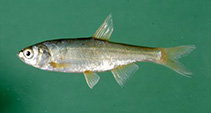
Acanthobrama telavivensis : fisheries

You can sponsor this page

Acanthobrama telavivensis Goren, Fishelson & Trewavas, 1973

Uploaden van uw Foto's en video's
Afbeeldingen | Google afbeelding
Image of Acanthobrama telavivensis
Acanthobrama telavivensis
Afbeelding van Darom, D.

Classificatie / Namen Lokale namen | Synoniemen | Catalog of Fishes(Genus, Soort(en)) | ITIS | CoL | WoRMS | Cloffa

> Cypriniformes (Carps) > Leuciscidae (Minnows) > Leuciscinae
Etymology: Acanthobrama: Greek, akantha = thorn + old French breme, bresme, a fresh water fish; 1460 (Ref. 45335).
More on authors: Goren, Fishelson & Trewavas.

Milieu: milieu / Klimaatzone / Diepte / verspreidingsgebied Ecologie

; zoet water benthopelagisch. Subtropical

Verspreiding Gebieden | FAO regio's | Ecosystemen | Voorkomen | Verspreidingskaart | Introducties | Faunafri

Eurasia: Tigris-Euphrates, Aleppo and Orontes water systems as well as in most waters of Israel. Has been threatened by water pollution (Ref. 11028).

Grootte / Gewicht / Leeftijd

Maturiteit: Lm ?  range ? - ? cm
Max length : 11.0 cm TL mannelijk / geslacht onbekend; (Ref. 11028)

Korte beschrijving Determinatiesleutels | Morfologie | Morfometrie

Dorsale stekels (totaal) : 2 - 3; Dorsale zachte stralen (totaal) : 7 - 8; Anale stekels: 3; Anale zachte stralen: 11 - 14. Compressed body, dorsal fin inserted behind the origin of pelvic fins. Mouth subterminal, lower jaw at an angle of 25-40° to the horizontal. Pharyngeal teeth 5-5. Silvery body with a dark lateral band.
Body shape (shape guide): fusiform / normal.

Biologie     Verklarende woordenlijst (bv. epibenthic)

Found in ponds and slow-moving rivers in very dense populations.

Levenscyclus en paargedrag Maturiteit | Voortplanting | Paaien | Eieren | Fecunditeit | Larven

Hoofdreferentie Upload uw referenties | Referenties | Coördinator | Medewerkers

Goren, M., 1974. The freshwater fishes of Israel. Isr. J. Zool. 23:67-118. (Ref. 11028)

Status op de Rode Lijst van het IUCN (Ref. 130435: Version 2025-2 (Global))

  Kwetsbaar (VU) (D2); Date assessed: 25 January 2013

CITES

Not Evaluated

CMS (Ref. 116361)

Not Evaluated

Gevaar voor de mens

  Harmless


Gebruik door de mens

Visserij: commercieel
FAO - Publication: search | FishSource |

Meer informatie

Trofische ecologie
Voedsel (prooien)
Dieetsamenstelling
Voedselconsumptie
Voedselrantsoenen
Predatoren
Ecologie
Ecologie
Populatiedynamica
Groeiparameters
Max. leeftijden / maten
Lengte-gewicht rel.
Lengte-lengte rel.
Lengtefrequenties
Massaconversie
Rekrutering
Abundantie
Levenscyclus
Voortplanting
Maturiteit
Rijpheid/kieuwen rel.
Fecunditeit
Paaien
Paaibestanden
Eieren
Ontwikkeling van de eieren
Larven
Larvale populatiedynamiek
Verspreiding
Gebieden
FAO regio's
Ecosystemen
Voorkomen
Introducties
BRUVS - Video's
Anatomie
Kieuwoppervlak
Hersenen
Otoliet
Fysiologie
Lichaamssamenstelling
Voedingsstoffen
Zuurstofverbruik
Type zwemmen
Zwemsnelheid
Visuele pigmenten
Vis geluid
Ziekten en parasieten
Toxiciteit (LC50)
Genetica
genoom
Genetica
Heterozygositeit
Erfelijkheid
Genetische diversiteit
Menselijk gerelateerd
Aquacultuursystemen
Aquacultuurprofielen
Kweeklijnen
Ciguatera gevallen
Postzegels, munten, diversen.
Outreach
Medewerkers
Referenties
Referenties

Tools

Speciale rapporten

Download XML

Internetbronnen

AFORO (otoliths) | Aquatic Commons | BHL | Cloffa | Websites from users | Bekijk FishWatcher | CISTI | Catalog of Fishes: Genus, Soort(en) | DiscoverLife | ECOTOX | FAO - Publication: search | Faunafri | Fishipedia | Fishtrace | GloBI | Google Books | Google Scholar | Google | IGFA World Record | OneZoom | Open Tree of Life | Otolith Atlas of Taiwan Fishes | PubMed | Reef Life Survey | Socotra Atlas | TreeBase | Tree of Life | Wikipedia: ga naar, zoek | World Records Freshwater Fishing | Zoobank | Zoological Record

Schattingen op basis van modellen

Fylogenetische diversiteitsindex (Ref. 82804):  PD50 = 0.5005   [Uniqueness, from 0.5 = low to 2.0 = high].
Bayesian length-weight: a=0.00724 (0.00353 - 0.01485), b=3.14 (2.97 - 3.31), in cm total length, based on LWR estimates for this (Sub)family-body shape (Ref. 93245).
Trofisch niveau (Ref. 69278):  2.9   ±0.4 se; based on size and trophs of closest relatives
Weerstandsvermogen (Ref. 120179):  Hoog, minimale populatieverdubbelingstijd minder dan 15 maanden (Preliminary K or Fecundity.).
Kwetsbaarheid van de visserij (Ref. 59153):  Low vulnerability (10 of 100). 🛈
Prijsklasse (Ref. 80766):   Unknown.