>
Pleuronectiformes (Flatfishes) >
Paralichthyidae (Large-tooth flounders)
Etymology: Paralichthys: Greek, para = the side of + Greek, ichthys = fish + Greek, suffix, oides = similar to (Ref. 45335).
Eponymy: Alcide Charles Victor Dessalines d’Orbigny (1802–1857) was a traveller, collector, illustrator and naturalist. [...] (Ref. 128868), visit book page.
More on author: Valenciennes.
Ambiente: milieu / zona climática / intervalo de profundidade / gama de distribuição
Ecologia
marinhas; estuarina demersal; oceanódromo; intervalo de profundidade 1 - 45 m (Ref. 43588), usually 1 - 20 m (Ref. 43588). Subtropical; 23°S - 41°S
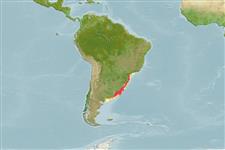
Southwest Atlantic: Rio de Janeiro, Brazil to at least Mar de la Plata, Argentina.
Comprimento na primeira maturidade / Tamanho / Peso / Idade
Maturidade: Lm ?, range 39 - ? cm
Max length : 83.0 cm TL macho/indeterminado; (Ref. 127691); common length : 32.0 cm SL macho/indeterminado; (Ref. 43588); Idade máx. registada: 11 anos (Ref. 127691)
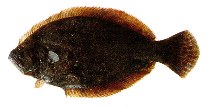
Espinhos dorsais (total) : 0; Raios dorsais moles (total) : 71 - 77; Espinhos anais: 0; Raios anais moles: 52 - 59; Vértebras: 35 - 36. Body shape oval, with the greatest breadth 2.5 times in length. Eyes are on the left side, close together, and equally in advance. Teeth are in a single series, sharply pointed. Dorsal fin origin aligned with eyes. Lateral line arched over the pectoral fin. Eye side of the body slightly rough, with finely ciliated scales (Ref. 3157).
Body shape (shape guide): short and / or deep; Cross section: flattened.
Populations are found in shallow coastal marine waters (Ref. 127691). They enter coastal lagoons (Ref. 36453). Nursery grounds are found in estuaries, coastal lagoons and brackish surf waters (Ref. 127691). Adults feed on pelagic and benthic species of crustaceans (penaeids and brachyurans), and lesser important fishes (Ref. 43588). Juveniles mainly feed on plolychaetes (Ref. 127691).
Ciclo de vida e comportamento de acasalamento
Maturidade | Reprodução | Desova | Ovos | Fecundidade | Larvas
Distinct pairing (Ref. 205).
Figueiredo, J.L. and N.A. Menezes, 2000. Manual de peixes marinhos do sudeste do Brasil. VI.Teleostei (5). Museu de Zoologia, Universidade de São Paulo. Brazil. 116 p. (Ref. 36453)
Categoria na Lista Vermelha da IUCN (Ref. 130435: Version 2025-2 (Global))
Ameaça para o homem
Harmless
Utilização humana
Pescarias: espécies comerciais
Ferramentas
Relatórios especiais
Descarregue XML
Fontes da internet
Estimativas baseadas em modelos
Temperatura preferida (Ref.
123201): 13.4 - 22.8, mean 16.1 °C (based on 118 cells).
Índice de diversidade filogenética (Ref.
82804): PD
50 = 0.5000 [Uniqueness, from 0.5 = low to 2.0 = high].
Bayesian length-weight: a=0.00692 (0.00443 - 0.01082), b=3.10 (2.97 - 3.23), in cm total length, based on LWR estimates for this species & Genus-body shape (Ref.
93245).
Nível Trófico (Ref.
69278): 3.5 ±0.54 se; based on food items.
Resiliência (Ref.
120179): Baixo, tempo mínimo de duplicação da população 4,5 - 14 anos (K = 0.12).
Vulnerabilidade da pesca (Ref.
59153): Moderate to high vulnerability (53 of 100).
🛈
Nutrientes (Ref.
124155): Calcium = 64.7 [29.4, 115.1] mg/100g; Iron = 0.905 [0.455, 1.626] mg/100g; Protein = 16.3 [13.9, 19.6] %; Omega3 = 0.173 [0.086, 0.325] g/100g; Selenium = 24.3 [11.4, 54.1] μg/100g; VitaminA = 11.9 [3.3, 46.1] μg/100g; Zinc = 0.681 [0.446, 1.021] mg/100g (wet weight);