>
Pleuronectiformes (Flatfishes) >
Paralichthyidae (Large-tooth flounders)
Etymology: Paralichthys: Greek, para = the side of + Greek, ichthys = fish + Greek, suffix, oides = similar to (Ref. 45335).
Eponymy: Alcide Charles Victor Dessalines d’Orbigny (1802–1857) was a traveller, collector, illustrator and naturalist. [...] (Ref. 128868), visit book page.
More on author: Valenciennes.
Umwelt: Milieu / Klimazone / Tiefenbereich / Verbreitungsgebiet
Ökologie
seewasser; brackwasser demersal; ozeanodrom; tiefenbereich 1 - 45 m (Ref. 43588), usually 1 - 20 m (Ref. 43588). Subtropical; 23°S - 41°S
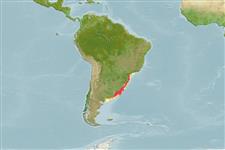
Southwest Atlantic: Rio de Janeiro, Brazil to at least Mar de la Plata, Argentina.
Länge bei der ersten Reifung / Größe / Gewicht / Alter
Geschlechtsreife: Lm ?, range 39 - ? cm
Max length : 83.0 cm TL Männchen/unbestimmt; (Ref. 127691); common length : 32.0 cm SL Männchen/unbestimmt; (Ref. 43588); max. veröff. Alter: 11 Jahre (Ref. 127691)
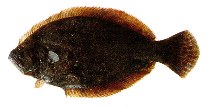
Rückenflossenstacheln (insgesamt) : 0; Rückenflossenweichstrahlen (insgesamt) : 71 - 77; Afterflossenstacheln: 0; Afterflossenweichstrahlen: 52 - 59; Wirbelzahl: 35 - 36. Body shape oval, with the greatest breadth 2.5 times in length. Eyes are on the left side, close together, and equally in advance. Teeth are in a single series, sharply pointed. Dorsal fin origin aligned with eyes. Lateral line arched over the pectoral fin. Eye side of the body slightly rough, with finely ciliated scales (Ref. 3157).
Body shape (shape guide): short and / or deep; Cross section: flattened.
Populations are found in shallow coastal marine waters (Ref. 127691). They enter coastal lagoons (Ref. 36453). Nursery grounds are found in estuaries, coastal lagoons and brackish surf waters (Ref. 127691). Adults feed on pelagic and benthic species of crustaceans (penaeids and brachyurans), and lesser important fishes (Ref. 43588). Juveniles mainly feed on plolychaetes (Ref. 127691).
Distinct pairing (Ref. 205).
Figueiredo, J.L. and N.A. Menezes, 2000. Manual de peixes marinhos do sudeste do Brasil. VI.Teleostei (5). Museu de Zoologia, Universidade de São Paulo. Brazil. 116 p. (Ref. 36453)
IUCN Rote Liste Status (Ref. 130435: Version 2025-2 (Global))
Bedrohung für Menschen
Harmless
Nutzung durch Menschen
Fischereien: kommerziell
Tools
Zusatzinformationen
Download XML
Internet Quellen
Schätzungen auf der Grundlage von Modellen
Bevorzugte Temperatur (Ref.
123201): 13.4 - 22.8, mean 16.1 °C (based on 118 cells).
Phylogenetischer Diversitätsindex (Ref.
82804): PD
50 = 0.5000 [Uniqueness, from 0.5 = low to 2.0 = high].
Bayesian length-weight: a=0.00692 (0.00443 - 0.01082), b=3.10 (2.97 - 3.23), in cm total length, based on LWR estimates for this species & Genus-body shape (Ref.
93245).
Trophische Ebene (Ref.
69278): 3.5 ±0.54 se; based on food items.
Widerstandsfähigkeit (Ref.
120179): niedrig, Verdopplung der Population dauert 4,5 - 14 Jahre. (K = 0.12).
Anfälligkeit der Fischerei (Ref.
59153): Moderate to high vulnerability (53 of 100).
🛈
Nährstoffe (Ref.
124155): Calcium = 64.7 [29.4, 115.1] mg/100g; Iron = 0.905 [0.455, 1.626] mg/100g; Protein = 16.3 [13.9, 19.6] %; Omega3 = 0.173 [0.086, 0.325] g/100g; Selenium = 24.3 [11.4, 54.1] μg/100g; VitaminA = 11.9 [3.3, 46.1] μg/100g; Zinc = 0.681 [0.446, 1.021] mg/100g (wet weight);