>
Blenniiformes (Blennies) >
Blenniidae (Combtooth blennies) > Salariinae
Etymology: Parablennius: Greek, para = the side of + Greek, blennios = mucus (Ref. 45335).
Eponymy: Demetrius Zvonimir (d: 1089) was King of Croatia and Dalmatia. The blenny was first identified from the Dalmatian coast. However, as the original text does not give an etymology, this remains a ‘best guess’ identification. (Ref. 128868), visit book page.
Περιβάλλον: περιβάλλον / κλιματική ζώνη / εύρος βάθους / εύρος διανομής
Οικολογία
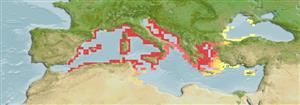
Θαλασσινό(ά) βενθικό(ς); εύρος βάθους 6 - 12 m (Ref. 80021). Subtropical; 47°N - 30°N, 6°W - 42°E
Mediterranean Sea and Black Sea.
Μέγεθος / Βάρος / Ηλικία
Γεννητική Ωρίμανση: Lm ? range ? - ? cm
Max length : 7.0 cm TL αρσενικό/απροσδιόριστο; (Ref. 5981)
Σύντομη περιγραφή
Κλείδες προσδιορισμού | Μορφολογία | Μορφομετρία
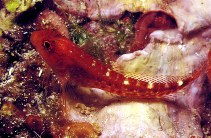
Ραχιαίες άκανθες (συνολικά) : 12; Μαλακές ραχιαίες ακτίνες (συνολικά) : 18; Εδρικές άκανθες: 2; Μαλακές εδρικές ακτίνες: 19 - 20.
Body shape (shape guide): fusiform / normal.
Facultative air-breathing in the genus (Ref. 126274); Adults inhabit dimly lit biotopes like overhanging rocks or caves. Also found in piddock holes. They graze on periphyton (Ref. 5981). Oviparous. Eggs are demersal and adhesive (Ref. 205), and are attached to the substrate via a filamentous, adhesive pad or pedestal (Ref. 94114). Larvae are planktonic, often found in shallow, coastal waters (Ref. 94114).
Κύκλος ζωής και συμπεριφορά ζευγαρώματος
Γεννητική Ωρίμανση | Αναπαραγωγή | Γεννοβολία | Αβγά | Γονιμότητα | Προνύμφες
Oviparous, distinct pairing (Ref. 205). Female deposit eggs inside an empty mussel, male tends the clutch (Ref. 47356). Courtship behavior entails males rearing up front of body (Ref. 5981). Yawning makes for a defense to drive away rivals (Ref. 5981).
Zander, C.D., 1986. Blenniidae. p. 1096-1112. In P.J.P. Whitehead, M.-L. Bauchot, J.-C. Hureau, J. Nielsen and E. Tortonese (eds.) Fishes of the North-eastern Atlantic and the Mediterranean, volume 3. UNESCO, Paris. (Ref. 5981)
Κατάσταση Κόκκινου Καταλόγου IUCN (Ref. 130435: Version 2025-2 (Global))
Απειλή για τον άνθρωπο
Harmless
Ανθρώπινες χρήσεις
Εργαλεία
Ειδικές εκθέσεις
Λήψη XML
Διαδικτυακές πηγές
Εκτιμήσεις βάσει μοντέλων
Προτιμώμενη θερμοκρασία (Αναφ.
123201): 16.8 - 19.7, mean 18.8 °C (based on 351 cells).
Δείκτης φυλογενετικής ποικιλότητας (Αναφ.
82804): PD
50 = 0.5000 [Uniqueness, from 0.5 = low to 2.0 = high].
Bayesian length-weight: a=0.01096 (0.00467 - 0.02573), b=2.99 (2.81 - 3.17), in cm total length, based on LWR estimates for this Genus-body shape (Ref.
93245).
Τροφικό Επίπεδο (Αναφ.
69278): 2.6 ±0.0 se; based on diet studies.
Ελαστικότητα (Αναφ.
120179): Υψηλό, ελάχιστος χρόνος για διπλασιασμό πληθυσμού < 15 μήνες (Preliminary K or Fecundity.).
Ευπάθεια στην αλιεία (Ref.
59153): Low vulnerability (10 of 100).
🛈
Θρεπτικά συστατικά (Ref.
124155): Calcium = 339 [168, 752] mg/100g; Iron = 1.92 [1.14, 3.53] mg/100g; Protein = 18.5 [17.5, 19.5] %; Omega3 = 0.354 [0.195, 0.644] g/100g; Selenium = 14.1 [6.8, 30.0] μg/100g; VitaminA = 22.2 [6.9, 70.3] μg/100g; Zinc = 1.76 [1.17, 2.63] mg/100g (wet weight);