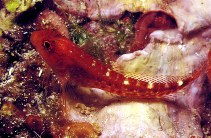
>
Blenniiformes (Blennies) >
Blenniidae (Combtooth blennies) > Salariinae
Etymology: Parablennius: Greek, para = the side of + Greek, blennios = mucus (Ref. 45335).
Eponymy: Demetrius Zvonimir (d: 1089) was King of Croatia and Dalmatia. The blenny was first identified from the Dalmatian coast. However, as the original text does not give an etymology, this remains a ‘best guess’ identification. (Ref. 128868), visit book page.
Umwelt: Milieu / Klimazone / Tiefenbereich / Verbreitungsgebiet
Ökologie
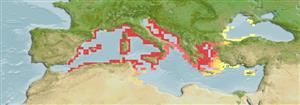
seewasser demersal; tiefenbereich 6 - 12 m (Ref. 80021). Subtropical; 47°N - 30°N, 6°W - 42°E
Mediterranean Sea and Black Sea.
Größe / Gewicht / Alter
Geschlechtsreife: Lm ? range ? - ? cm
Max length : 7.0 cm TL Männchen/unbestimmt; (Ref. 5981)
Rückenflossenstacheln (insgesamt) : 12; Rückenflossenweichstrahlen (insgesamt) : 18; Afterflossenstacheln: 2; Afterflossenweichstrahlen: 19 - 20.
Body shape (shape guide): fusiform / normal.
Facultative air-breathing in the genus (Ref. 126274); Adults inhabit dimly lit biotopes like overhanging rocks or caves. Also found in piddock holes. They graze on periphyton (Ref. 5981). Oviparous. Eggs are demersal and adhesive (Ref. 205), and are attached to the substrate via a filamentous, adhesive pad or pedestal (Ref. 94114). Larvae are planktonic, often found in shallow, coastal waters (Ref. 94114).
Lebenszyklus und Paarungsverhalten
Geschlechtsreife | Fortpflanzung | Ablaichen | Eier | Fruchtbarkeit | Larven
Oviparous, distinct pairing (Ref. 205). Female deposit eggs inside an empty mussel, male tends the clutch (Ref. 47356). Courtship behavior entails males rearing up front of body (Ref. 5981). Yawning makes for a defense to drive away rivals (Ref. 5981).
Zander, C.D., 1986. Blenniidae. p. 1096-1112. In P.J.P. Whitehead, M.-L. Bauchot, J.-C. Hureau, J. Nielsen and E. Tortonese (eds.) Fishes of the North-eastern Atlantic and the Mediterranean, volume 3. UNESCO, Paris. (Ref. 5981)
IUCN Rote Liste Status (Ref. 130435: Version 2025-2 (Global))
Bedrohung für Menschen
Harmless
Nutzung durch Menschen
Tools
Zusatzinformationen
Download XML
Internet Quellen
Schätzungen auf der Grundlage von Modellen
Bevorzugte Temperatur (Ref.
123201): 16.8 - 19.7, mean 18.8 °C (based on 351 cells).
Phylogenetischer Diversitätsindex (Ref.
82804): PD
50 = 0.5000 [Uniqueness, from 0.5 = low to 2.0 = high].
Bayesian length-weight: a=0.01096 (0.00467 - 0.02573), b=2.99 (2.81 - 3.17), in cm total length, based on LWR estimates for this Genus-body shape (Ref.
93245).
Trophische Ebene (Ref.
69278): 2.6 ±0.0 se; based on diet studies.
Widerstandsfähigkeit (Ref.
120179): hoch, Verdopplung der Population dauert weniger als 15 Monate. (Preliminary K or Fecundity.).
Anfälligkeit der Fischerei (Ref.
59153): Low vulnerability (10 of 100).
🛈
Nährstoffe (Ref.
124155): Calcium = 339 [168, 752] mg/100g; Iron = 1.92 [1.14, 3.53] mg/100g; Protein = 18.5 [17.5, 19.5] %; Omega3 = 0.354 [0.195, 0.644] g/100g; Selenium = 14.1 [6.8, 30.0] μg/100g; VitaminA = 22.2 [6.9, 70.3] μg/100g; Zinc = 1.76 [1.17, 2.63] mg/100g (wet weight);