Milieu: milieu / Klimaatzone / Diepte / verspreidingsgebied
Ecologie
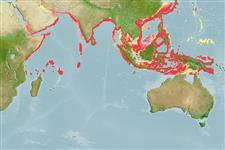
marien; brak water benthopelagisch; oceanodroom (Ref. 51243); diepte 50 - ? m (Ref. 9987). Tropical; 31°N - 12°S, 40°E - 153°E (Ref. 54462)
Indo-West Pacific: Somalia to Papua New Guinea, north to Japan and south to Indonesia.
Lengte bij maturiteit / Grootte / Gewicht / Leeftijd
Maturiteit: Lm ?, range 13 - ? cm
Max length : 61.0 cm TL mannelijk / geslacht onbekend; (Ref. 43449); common length : 25.0 cm TL mannelijk / geslacht onbekend; (Ref. 30573)
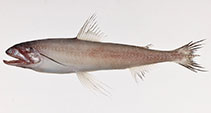
Dorsale stekels (totaal) : 0; Dorsale zachte stralen (totaal) : 11 - 13; Anale stekels: 0; Anale zachte stralen: 13 - 15. Scales restricted to posterior half of the body. Posterior tip of pectoral fin reaching origin of pelvic fin.
Body shape (shape guide): elongated.
Inhabit deep water offshore on sandy mud bottom for most of the year, but also gathers in large shoals in deltas of rivers to feed during monsoons (Ref. 9987, 11230). Spawn 6 batches of broods per year (Ref. 43449). An aggressive predator (Ref. 9987). Primarily caught along Maharashtra with the bag-net, better known as 'dol' net. Operation of this gear is timed to a strong tidal current. The bag with the mouth set against the current strains the fish which is being retained therein by the strength of the current. The net is thus retrieved before the tide turns. Very phosphorescent. Excellent food fish. Marketed fresh and dried or salted; consumed pan-fried (Ref. 9987).
Whitehead, P.J.P., 1984. Harpadontidae. In W. Fischer and G. Bianchi (eds.) FAO species identification sheets for fishery purposes. Western Indian Ocean fishing area 51. Vol. 2. [pag. var.]. FAO, Rome. (Ref. 3417)
Status op de Rode Lijst van het IUCN (Ref. 130435: Version 2025-2 (Global))
Gevaar voor de mens
Harmless
Gebruik door de mens
Visserij: van groot commercieel belang
Tools
Speciale rapporten
Download XML
Internetbronnen
Schattingen op basis van modellen
Gewenste temperatuur (Ref.
123201): 16.8 - 26, mean 21.2 °C (based on 405 cells).
Fylogenetische diversiteitsindex (Ref.
82804): PD
50 = 0.5078 [Uniqueness, from 0.5 = low to 2.0 = high].
Bayesian length-weight: a=0.00427 (0.00333 - 0.00547), b=3.14 (3.08 - 3.20), in cm total length, based on LWR estimates for this species (Ref.
93245).
Trofisch niveau (Ref.
69278): 4.1 ±0.74 se; based on food items.
Generation time: 1.5 (1.1 - 2.1) years. Estimated as median ln(3)/K based on 10
growth studies.
Weerstandsvermogen (Ref.
120179): Hoog, minimale populatieverdubbelingstijd minder dan 15 maanden (K=0.18-0.9; Fec=89,600).
Prior r = 1.16, 95% CL = 0.77 - 1.75, Based on 5 data-limited stock assessments.
Kwetsbaarheid van de visserij (Ref.
59153): Low to moderate vulnerability (26 of 100).
🛈
Kwetsbaarheid voor het klimaat (Ref.
125649): Moderate to high vulnerability (53 of 100).
🛈
Voedingsstoffen (Ref.
124155): Calcium = 58.7 [27.2, 166.1] mg/100g; Iron = 0.333 [0.155, 0.934] mg/100g; Protein = 12.3 [10.2, 15.6] %; Omega3 = 0.0747 [, ] g/100g; Selenium = 28 [12, 74] μg/100g; VitaminA = 8.22 [2.60, 29.21] μg/100g; Zinc = 0.368 [0.246, 0.916] mg/100g (wet weight); based on
nutrient studies.