>
Cypriniformes (Carps) >
Leuciscidae (Minnows) > Leuciscinae
Etymology: Petroleuciscus: Named for Petru Bănărescu, a famous freshwater ichthyologist and Petr Naseka, son of the genus author, and Leuciscus, a related genus.
Môi trường: môi trường / vùng khí hậu / Mức độ sâu / phạm vi phân phối
Sinh thái học
; nước ngọt; thuộc về nước lợ sống nổi và đáy. Temperate; 56°N - 39°N, 26°E - 47°E
Eurasia: Western, northern and eastern Black Sea and Sea of Azov basins, from Bulgaria clock-wise to Kizilirmak drainage in northern-central Turkey (missing in Don); Aegean Sea basin, from Strma drainage eastward in Europe; northwestern Turkey. In lower reaches of rivers and coastal lakes, but in Dniepr up to Seim and Desna systems.
Bộ gần gũi / Khối lượng (Trọng lượng) / Tuổi
Chín muồi sinh dục: Lm ? range ? - ? cm
Max length : 40.0 cm TL con đực/không giới tính; (Ref. 556); common length : 18.0 cm TL con đực/không giới tính; (Ref. 556); Tuổi cực đại được báo cáo: 8 các năm (Ref. 59043)
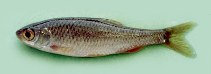
Các tia vây lưng cứng (tổng cộng) : 3 - 4; Các vây lưng mềm (tổng cộng) : 8 - 10; Tia cứng vây hậu môn: 3 - 4; Tia mềm vây hậu môn: 9 - 12; Động vật có xương sống: 36 - 38. Differs from Petroleuciscus smyrnaeus by having the following characters: dorsal fin with 8-9½ branched rays; ; anal fin with 9-10½ branched rays; iris orange to red; lateral line with 33-40 scales; posterior margin of anal convex or almost straight; without back pigments along free margin of each flank scale (Ref. 59043).
Body shape (shape guide): fusiform / normal.
Adults inhabit lowland rivers, lower reaches of montane rivers, limans, lakes, deltas, backwaters with moderate to no current. They prefer to stay in warm water with temperatures up to 30-32° C, on sand, sand-mud or mud bottom, and in shallow places with slow current along banks, in backwaters, in small lakes and similar calm-water sites. Can tolerate slightly brackish water and low oxygen concentrations. Feed predominantly on insects and their larvae, but also takes plankton, benthic invertebrates and algae. Form spawning groups of up to 150 individuals. They do not undertake migration but move to deeper places in winter. Sharp decline of some populations is due to drainage of flood-plains and channelization of river beds (Ref. 59043).
Form spawning groups of up to 150 individuals (Ref. 59043). Asynchronous spawning, occurs two or three times in the season from the beginning of May to June (Ref. 74544). A hermaphrodite specimen was found, having a pair of testes and an ovary, the eggs being degenerated (Ref. 74544).
Kottelat, M. and J. Freyhof, 2007. Handbook of European freshwater fishes. Publications Kottelat, Cornol and Freyhof, Berlin. 646 pp. (Ref. 59043)
Tình trạng Sách đỏ IUCN (Ref. 130435: Version 2025-2 (Global))
Mối đe dọa đối với con người
Harmless
Sử dụng của con người
Các nghề cá: không ích lợi (thú vị)
Các công cụ
Báo cáo đặc biệt
Tải xuống XML
Các nguồn internet
Ước tính dựa trên mô hình
Chỉ số đa dạng phát sinh loài (Tài liệu tham khảo
82804): PD
50 = 0.6250 [Uniqueness, from 0.5 = low to 2.0 = high].
Bayesian length-weight: a=0.00724 (0.00649 - 0.00808), b=3.13 (3.10 - 3.16), in cm total length, based on LWR estimates for this species (Ref.
93245).
Mức dinh dưỡng (Tài liệu tham khảo
69278): 3.1 ±0.35 se; based on food items.
Thích nghi nhanh (Tài liệu tham khảo
120179): Trung bình, thời gian nhân đôi của chủng quần tối thiểu là 1.4 - 4.4 năm (tm=2-3; Fec = 5,890).
Sự dễ bị tổn thương của nghề đánh cá (Ref.
59153): Low to moderate vulnerability (30 of 100).
🛈