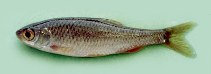
Klassifizierung / Names
Namen | Synonyme | Catalog of Fishes(Gattung, Arten) | ITIS | CoL | WoRMS | Cloffa
>
Cypriniformes (Carps) >
Leuciscidae (Minnows) > Leuciscinae
Etymology: Petroleuciscus: Named for Petru Bănărescu, a famous freshwater ichthyologist and Petr Naseka, son of the genus author, and Leuciscus, a related genus.
Umwelt: Milieu / Klimazone / Tiefenbereich / Verbreitungsgebiet
Ökologie
; süßwasser; brackwasser benthopelagisch. Temperate; 56°N - 39°N, 26°E - 47°E
Eurasia: Western, northern and eastern Black Sea and Sea of Azov basins, from Bulgaria clock-wise to Kizilirmak drainage in northern-central Turkey (missing in Don); Aegean Sea basin, from Strma drainage eastward in Europe; northwestern Turkey. In lower reaches of rivers and coastal lakes, but in Dniepr up to Seim and Desna systems.
Größe / Gewicht / Alter
Geschlechtsreife: Lm ? range ? - ? cm
Max length : 40.0 cm TL Männchen/unbestimmt; (Ref. 556); common length : 18.0 cm TL Männchen/unbestimmt; (Ref. 556); max. veröff. Alter: 8 Jahre (Ref. 59043)
Rückenflossenstacheln (insgesamt) : 3 - 4; Rückenflossenweichstrahlen (insgesamt) : 8 - 10; Afterflossenstacheln: 3 - 4; Afterflossenweichstrahlen: 9 - 12; Wirbelzahl: 36 - 38. Differs from Petroleuciscus smyrnaeus by having the following characters: dorsal fin with 8-9½ branched rays; ; anal fin with 9-10½ branched rays; iris orange to red; lateral line with 33-40 scales; posterior margin of anal convex or almost straight; without back pigments along free margin of each flank scale (Ref. 59043).
Body shape (shape guide): fusiform / normal.
Adults inhabit lowland rivers, lower reaches of montane rivers, limans, lakes, deltas, backwaters with moderate to no current. They prefer to stay in warm water with temperatures up to 30-32° C, on sand, sand-mud or mud bottom, and in shallow places with slow current along banks, in backwaters, in small lakes and similar calm-water sites. Can tolerate slightly brackish water and low oxygen concentrations. Feed predominantly on insects and their larvae, but also takes plankton, benthic invertebrates and algae. Form spawning groups of up to 150 individuals. They do not undertake migration but move to deeper places in winter. Sharp decline of some populations is due to drainage of flood-plains and channelization of river beds (Ref. 59043).
Form spawning groups of up to 150 individuals (Ref. 59043). Asynchronous spawning, occurs two or three times in the season from the beginning of May to June (Ref. 74544). A hermaphrodite specimen was found, having a pair of testes and an ovary, the eggs being degenerated (Ref. 74544).
Kottelat, M. and J. Freyhof, 2007. Handbook of European freshwater fishes. Publications Kottelat, Cornol and Freyhof, Berlin. 646 pp. (Ref. 59043)
IUCN Rote Liste Status (Ref. 130435: Version 2025-2 (Global))
Bedrohung für Menschen
Harmless
Nutzung durch Menschen
Fischereien: nicht kommerziell
Tools
Zusatzinformationen
Download XML
Internet Quellen
Schätzungen auf der Grundlage von Modellen
Phylogenetischer Diversitätsindex (Ref.
82804): PD
50 = 0.6250 [Uniqueness, from 0.5 = low to 2.0 = high].
Bayesian length-weight: a=0.00724 (0.00649 - 0.00808), b=3.13 (3.10 - 3.16), in cm total length, based on LWR estimates for this species (Ref.
93245).
Trophische Ebene (Ref.
69278): 3.1 ±0.35 se; based on food items.
Widerstandsfähigkeit (Ref.
120179): mittel, Verdopplung der Population dauert 1,4 - 4,4 Jahre. (tm=2-3; Fec = 5,890).
Anfälligkeit der Fischerei (Ref.
59153): Low to moderate vulnerability (30 of 100).
🛈