>
Petromyzontiformes (Lampreys) >
Petromyzontidae (Northern lampreys) > Lampetrinae
Etymology: Lampetra: lambo (L.), to lick; petra (Gr.), rock or stone, referring to their suctorial behavior (adults attach to rocks during nest building and mating) (See ETYFish); zanandreai: In honor of Giuseppe Zanandrea (1907-1965), Istituto di Anatomia Comparata della Università di Bologna, “who made several interesting biometrical and biological studies of lampreys from northern Italy” (See ETYFish).
Eponymy: Dr Giuseppe Zanandrea (1907–1965) was a Jesuit priest who worked at Istituto di Zoologia e Anatomia comparata, Universita di Padova (1959) and Istituto di Anatomia Comparata della Università di Bologna. [...] (Ref. 128868), visit book page.
Taxonomic Remarks
Genus placement still uncertain. Needs more work or send publications.
Окружающая среда: среда / климатическая зона / пределы глубины / диапазон распространения
экология
; пресноводный демерсальный; немигрирующий. Temperate; 5°C - 20°C (Ref. 12320); 47°N - 44°N, 9°E - 15°E
Europe: Alpine slope of Po to Soca drainages (Italy, Switzerland, Slovenia), Esino and Potenza drainages on Adriatic coast of Central Italy; Mirna (Croatia) and Neretva drainage (Bosnia-Herzegovina, Croatia).
Длина при первой зрелости / Размер / Вес / Возраст
половая зрелость: Lm 14.0, range 8 - 20 cm
Max length : 26.0 cm TL самец/пол неопределен; (Ref. 59043); наибольший возраст (опубликованны данные): 6 годы (Ref. 12320)
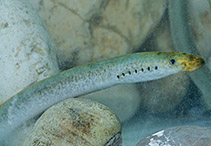
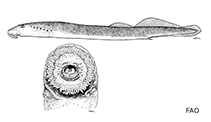
Adults: 11.8-15.6 cm TL. Body proportions, as percentage of TL (based on 19 specimens measuring 11.8-15.6 cm TL): prebranchial length, 10.2-13.7; branchial length, 9.3-11.9; trunk length, 45.5-52.6; tail length, 24.0-28.7; eye length, 1.6-2.5; disc length, 4.6-6.9. Urogenital papilla length, as a percentage of branchial length, in six spawning males measuring 12.8-13.9 cm TL, 23.5-40.0. Trunk myomeres, 54-60. Dentition: supraoral lamina, 2 unicuspid teeth; infraoral lamina, 5-8 unicuspid teeth, usually 7; three endolaterals on each side; endolateral formula, typically 2-3-2 (2-2-2 in the holotype); 2 rows of anterials; first row of anterials, 4 unicuspid teeth; 0-1 row of exolaterals on each side; single incomplete row of posterials with 2-5 unicuspid teeth (2 in the holotype); transverse lingual lamina, 5-7 unicuspid teeth, the median one enlarged; longitudinal lingual laminae each with about 6 or 7 unicuspid teeth. Velar tentacles, 3-5, with tubercles. Body coloration (preserved), dorsal and lateral aspects grayish, ventral surface whitish, dorsal fins and caudal fin yellowish. No dark blotch near the apex of the second dorsal fin. Lateral line neuromasts unpigmented. Caudal fin shape, spade-like.
Body shape (shape guide): eel-like.
Freshwater (Ref. 89241, 12320). Occurs in clean, cold water usually near springs in the foot-hill zone, over muddy or sandy bottom (Ref. (Ref. 12320). Ammocoetes inhabits detritus-rich sands or clay sediments (Ref. 59043). They are filter bottom-feeders. Metamorphosis takes place after 4.5 years (Ref. 12320). Short-lived, non-parasitic (Ref. 12320, 89241). Reproduction takes place from January to June. Its existence is threatened by habitat destruction and water abstraction (Ref. 26100).
Bianco, P.G., 1986. Lethenteron zanandreai (Vladykov, 1955). p. 237-246. In J. Holcík (ed.) The freshwater fishes of Europe. Vol. 1, Part 1. Petromyzontiformes. (Ref. 12320)
Статус Красного Списка МСОП (Ref. 130435: Version 2025-2 (Global))
Угроза для людей
Harmless
Использование человеком
рыболовство: интереса не представляет; наживка: occasionally
дополнительная информация
инструменты
Специальные отчеты
Скачать в формате XML
ресурсы в Интернет
Оценки, основанные на моделях
Индекс филогенетического разнообразия (ссылка
82804): PD
50 = 0.5010 [Uniqueness, from 0.5 = low to 2.0 = high].
Bayesian length-weight: a=0.00132 (0.00060 - 0.00290), b=2.99 (2.80 - 3.18), in cm total length, based on LWR estimates for this (Sub)family-body shape (Ref.
93245).
Трофический уровень (ссылка
69278): 3.5 ±0.37 se; based on food items.
устойчивость к внешним воздействиям (ссылка
120179): низкий, минимальное время удвоения популяции 4.5-14 лет (tm=5; tmax=5.5; Fec=2,000).
Уязвимость рыбной ловли (Ref.
59153): Low vulnerability (16 of 100).
🛈