Klassifizierung / Names
Namen | Synonyme | Catalog of Fishes(Gattung, Arten) | ITIS | CoL | WoRMS | Cloffa
>
Petromyzontiformes (Lampreys) >
Petromyzontidae (Northern lampreys) > Lampetrinae
Etymology: Lampetra: lambo (L.), to lick; petra (Gr.), rock or stone, referring to their suctorial behavior (adults attach to rocks during nest building and mating) (See ETYFish); zanandreai: In honor of Giuseppe Zanandrea (1907-1965), Istituto di Anatomia Comparata della Università di Bologna, “who made several interesting biometrical and biological studies of lampreys from northern Italy” (See ETYFish).
Eponymy: Dr Giuseppe Zanandrea (1907–1965) was a Jesuit priest who worked at Istituto di Zoologia e Anatomia comparata, Universita di Padova (1959) and Istituto di Anatomia Comparata della Università di Bologna. [...] (Ref. 128868), visit book page.
Taxonomic Remarks
Genus placement still uncertain. Needs more work or send publications.
Umwelt: Milieu / Klimazone / Tiefenbereich / Verbreitungsgebiet
Ökologie
; süßwasser demersal; standorttreu. Temperate; 5°C - 20°C (Ref. 12320); 47°N - 44°N, 9°E - 15°E
Europe: Alpine slope of Po to Soca drainages (Italy, Switzerland, Slovenia), Esino and Potenza drainages on Adriatic coast of Central Italy; Mirna (Croatia) and Neretva drainage (Bosnia-Herzegovina, Croatia).
Länge bei der ersten Reifung / Größe / Gewicht / Alter
Geschlechtsreife: Lm 14.0, range 8 - 20 cm
Max length : 26.0 cm TL Männchen/unbestimmt; (Ref. 59043); max. veröff. Alter: 6 Jahre (Ref. 12320)
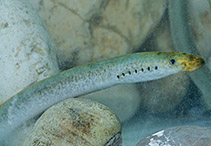
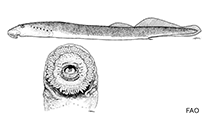
Adults: 11.8-15.6 cm TL. Body proportions, as percentage of TL (based on 19 specimens measuring 11.8-15.6 cm TL): prebranchial length, 10.2-13.7; branchial length, 9.3-11.9; trunk length, 45.5-52.6; tail length, 24.0-28.7; eye length, 1.6-2.5; disc length, 4.6-6.9. Urogenital papilla length, as a percentage of branchial length, in six spawning males measuring 12.8-13.9 cm TL, 23.5-40.0. Trunk myomeres, 54-60. Dentition: supraoral lamina, 2 unicuspid teeth; infraoral lamina, 5-8 unicuspid teeth, usually 7; three endolaterals on each side; endolateral formula, typically 2-3-2 (2-2-2 in the holotype); 2 rows of anterials; first row of anterials, 4 unicuspid teeth; 0-1 row of exolaterals on each side; single incomplete row of posterials with 2-5 unicuspid teeth (2 in the holotype); transverse lingual lamina, 5-7 unicuspid teeth, the median one enlarged; longitudinal lingual laminae each with about 6 or 7 unicuspid teeth. Velar tentacles, 3-5, with tubercles. Body coloration (preserved), dorsal and lateral aspects grayish, ventral surface whitish, dorsal fins and caudal fin yellowish. No dark blotch near the apex of the second dorsal fin. Lateral line neuromasts unpigmented. Caudal fin shape, spade-like.
Body shape (shape guide): eel-like.
Freshwater (Ref. 89241, 12320). Occurs in clean, cold water usually near springs in the foot-hill zone, over muddy or sandy bottom (Ref. (Ref. 12320). Ammocoetes inhabits detritus-rich sands or clay sediments (Ref. 59043). They are filter bottom-feeders. Metamorphosis takes place after 4.5 years (Ref. 12320). Short-lived, non-parasitic (Ref. 12320, 89241). Reproduction takes place from January to June. Its existence is threatened by habitat destruction and water abstraction (Ref. 26100).
Bianco, P.G., 1986. Lethenteron zanandreai (Vladykov, 1955). p. 237-246. In J. Holcík (ed.) The freshwater fishes of Europe. Vol. 1, Part 1. Petromyzontiformes. (Ref. 12320)
IUCN Rote Liste Status (Ref. 130435: Version 2025-2 (Global))
Bedrohung für Menschen
Harmless
Nutzung durch Menschen
Fischereien: nicht kommerziell; Köder: occasionally
Tools
Zusatzinformationen
Download XML
Internet Quellen
Schätzungen auf der Grundlage von Modellen
Phylogenetischer Diversitätsindex (Ref.
82804): PD
50 = 0.5010 [Uniqueness, from 0.5 = low to 2.0 = high].
Bayesian length-weight: a=0.00132 (0.00060 - 0.00290), b=2.99 (2.80 - 3.18), in cm total length, based on LWR estimates for this (Sub)family-body shape (Ref.
93245).
Trophische Ebene (Ref.
69278): 3.5 ±0.37 se; based on food items.
Widerstandsfähigkeit (Ref.
120179): niedrig, Verdopplung der Population dauert 4,5 - 14 Jahre. (tm=5; tmax=5.5; Fec=2,000).
Anfälligkeit der Fischerei (Ref.
59153): Low vulnerability (16 of 100).
🛈