Élasmobranches (requins et raies) (sharks and rays) >
Myliobatiformes (Stingrays) >
Myliobatidae (Eagle and manta rays)
Etymology: Myliobatis: Greek, mylo = mill + Greek, + Greek, batis,-idos = a ray (Raja sp.) (Ref. 45335).
More on author: Gill.
Environnement : milieu / zone climatique / profondeur / gamme de distribution
Écologie
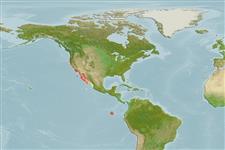
marin démersal; profondeur 0 - 108 m (Ref. 96339). Subtropical; 43°N - 5°S, 126°W - 85°W (Ref. 55258)
Eastern Pacific: Oregon, USA to Gulf of California (Ref. 2850) and the Galapagos Islands (Ref. 28023).
Taille / Poids / Âge
Maturité: Lm ? range ? - ? cm
Max length : 180 cm WD mâle / non sexé; (Ref. 2850); common length : 100.0 cm WD mâle / non sexé; (Ref. 9257); poids max. publié: 82.1 kg (Ref. 40637)
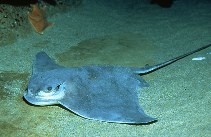
Commonly found in sandy and muddy bays and sloughs, also on rocky bottom and in kelp beds (Ref. 2850). Sometimes buries itself in sand (Ref. 2850). Found singly or in schools (Ref. 12951). Feeds on bivalves, snails, polychaetes, shrimps, and crabs (Ref. 9257). Ovoviviparous (Ref. 50449). Venomous spine on tail. Not fished commercially, but shows up as by-catch species (Ref. 9257).
Cycle de vie et comportement reproducteur
Maturité | Reproduction | Frai | Œufs | Fécondité | Larves
Exhibit ovoviparity (aplacental viviparity), with embryos feeding initially on yolk, then receiving additional nourishment from the mother by indirect absorption of uterine fluid enriched with mucus, fat or protein through specialised structures (Ref. 50449).
McEachran, J.D. and G. Notarbartolo di Sciara, 1995. Myliobatidae. Aguilas marinas. p. 765-768. In W. Fischer, F. Krupp, W. Schneider, C. Sommer, K.E. Carpenter and V. Niem (eds.) Guia FAO para Identification de Especies para los Fines de la Pesca. Pacifico Centro-Oriental. 3 Vols. FAO, Rome. (Ref. 9257)
Statut dans la liste rouge de l'IUCN (Ref. 130435: Version 2025-2 (Global))
Utilisations par l'homme
Pêcheries: commercial; pêche sportive: oui; Aquarium: Aquariums publics
Outils
Articles particuliers
Télécharger en XML
Sources Internet
Estimations basées sur des modèles
Température préférée (Réf.
123201): 12.4 - 23, mean 20.6 °C (based on 34 cells).
Indice de diversité phylogénétique (Réf.
82804): PD
50 = 0.5002 [Uniqueness, from 0.5 = low to 2.0 = high].
Bayesian length-weight: a=0.00389 (0.00124 - 0.01219), b=3.08 (2.83 - 3.33), in cm total length, based on LWR estimates for this (Sub)family-body shape (Ref.
93245).
Niveau trophique (Réf.
69278): 3.2 ±0.1 se; based on diet studies.
Résilience (Réf.
120179): Faible, temps minimum de doublement de population : 4,5 à 14 années (tm=3; tmax=23; k=0.09-0.22).
Vulnérabilité de la pêche (Ref.
59153): Very high vulnerability (75 of 100).
🛈
Nutriments (Ref.
124155): Calcium = 8.59 [1.10, 170.56] mg/100g; Iron = 0.647 [0.059, 7.948] mg/100g; Protein = 20.5 [15.2, 25.6] %; Omega3 = 0.159 [0.050, 0.437] g/100g; Selenium = 28.9 [5.9, 146.1] μg/100g; VitaminA = 3.22 [0.27, 34.64] μg/100g; Zinc = 0.476 [0.031, 5.520] mg/100g (wet weight);