>
Perciformes/Serranoidei (Groupers) >
Anthiadidae (Fairy basslets or Streamer basses)
Etymology: Choranthias: Name from Greek 'chora' for room or space and 'anthias' meaning a seafish; an allusion to the interruption of the lateral line in the species of this genus.
Meio ambiente: milieu / Zona climática / intervalo de profundidade / faixa de distribuição
Ecologia
marinhas demersal; intervalo de profundidade 30 - 55 m (Ref. 58184). Tropical
Eastern Central Atlantic: endemic to St. Paul's Rocks.
Tamanho / Peso / Idade
Maturidade: Lm ? range ? - ? cm
Max length : 6.1 cm SL macho/indeterminado; (Ref. 13121)
Descrição suscinta
Chaves de identificação | Morfologia | Morfometria
Espinhos dorsais (total) : 10; Raios dorsais (total) : 15; Espinhos anais: 3; Raios anais : 7. This species distinguished from it congeners by the following set of characters: A 7; 46-51 lateral-line scales; total gill rakers on first arch 32-35 (Ref. 90266).
Body shape (shape guide): fusiform / normal; Cross section: compressed.
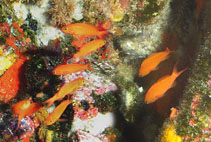
This species, which was seen again at St. Paul's Rocks after almost 30 years of its first description, was observed between 35 and 55 m and was most abundant between 40 and 45 m on almost-vertical rock drop offs. It aggregates in small groups of 5 to 10 individuals, swimming close to crevices into which they hide when threatened. Several such groups were observed, with each group taking refuge in its own crevice when approached by a diver. Apparently, there is no exchange of individuals between groups or crevices, suggesting that appropriate shelter is one of the factors limiting the distribution of this species. Individuals were observed to leave a shelter only when a school of juvenile Chromis multilineata (Guichenot, 1853) approached the cliffs. Both species are quite similar in shape and, at depths with available light, are almost identical in coloration (faded-brown). Presumably, A. salmopunctatus gets protective advantages of schooling with a similar species in larger, multispecific groups while foraging on open water plankton. Although neither A. salmopunctatus nor other endemic fishes in the area may be under great risk of extinction (as their habitat is not directly affected by human activities), such extreme restricted geographic distribution is sufficient to consider the species threatened, as they could be vulnerable to natural impacts. A. salmopunctatus and Prognathodes obliquus have been reported show low densities and seem to have low absolute numbers. The latter may be a bias due to the fact that only the shallow portion of the depth range is being sampled or, alternatively, the species really have low population densities. A precise evaluation of the risks of extinction urgently requires extensive work to better estimate the distribution and population size of this species (Ref. 58184).
Ciclo de vida ou comportamento de acasalamento
Maturidade | Reprodução | Desova | Ovos | Fecundidade | Larvas
Lubbock, R. and A. Edwards, 1981. The fishes of Saint Paul's Rocks. J. Fish Biol. 18(2):135-157. (Ref. 13121)
Status na Lista Vermelha da UICN (Ref. 130435: Version 2025-2 (Global))
Ameaça para os humanos
Harmless
Uso pelos humanos
Ferramentas
Relatórios especiais
Baixar XML
Fontes da internet
Estimativas baseadas em modelos
Temperatura preferida (Ref.
123201): 26.3 - 27.3, mean 27.3 °C (based on 3 cells).
Índice de diversidade filogenética (Ref.
82804): PD
50 = 0.7500 [Uniqueness, from 0.5 = low to 2.0 = high].
Bayesian length-weight: a=0.01413 (0.00621 - 0.03212), b=3.00 (2.81 - 3.19), in cm total length, based on LWR estimates for this (Sub)family-body shape (Ref.
93245).
Nível Trófico (Ref.
69278): 3.3 ±0.4 se; based on size and trophs of closest relatives
Resiliência (Ref.
120179): Elevada, tempo mínimo de duplicação da população menor que 15 meses (Preliminary K or Fecundity.).
Vulnerabilidade da pesca (Ref.
59153): Low vulnerability (10 of 100).
🛈