>
Perciformes/Serranoidei (Groupers) >
Anthiadidae (Fairy basslets or Streamer basses)
Etymology: Choranthias: Name from Greek 'chora' for room or space and 'anthias' meaning a seafish; an allusion to the interruption of the lateral line in the species of this genus.
Lingkungan: lingkungan / zona iklim / kisaran kedalaman / jangkauan distribusi
Ekologi
laut dasar (demersal); kisaran kedalaman 30 - 55 m (Ref. 58184). Tropical
Eastern Central Atlantic: endemic to St. Paul's Rocks.
Ukuran / Berat / umur
Kematangan: Lm ? range ? - ? cm
Max length : 6.1 cm SL jantan/; (Ref. 13121)
deskripsi pendek
Kunci identifiaksi (pengenalan) | Morfologi | Morfometrik
Duri punggung (Keseluruhan (total)) : 10; duri punggung lunak (Keseluruhan (total)) : 15; Duri dubur: 3; Sirip dubur lunak: 7. This species distinguished from it congeners by the following set of characters: A 7; 46-51 lateral-line scales; total gill rakers on first arch 32-35 (Ref. 90266).
Body shape (shape guide): fusiform / normal; Cross section: compressed.
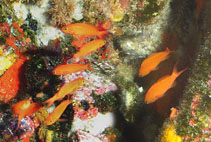
This species, which was seen again at St. Paul's Rocks after almost 30 years of its first description, was observed between 35 and 55 m and was most abundant between 40 and 45 m on almost-vertical rock drop offs. It aggregates in small groups of 5 to 10 individuals, swimming close to crevices into which they hide when threatened. Several such groups were observed, with each group taking refuge in its own crevice when approached by a diver. Apparently, there is no exchange of individuals between groups or crevices, suggesting that appropriate shelter is one of the factors limiting the distribution of this species. Individuals were observed to leave a shelter only when a school of juvenile Chromis multilineata (Guichenot, 1853) approached the cliffs. Both species are quite similar in shape and, at depths with available light, are almost identical in coloration (faded-brown). Presumably, A. salmopunctatus gets protective advantages of schooling with a similar species in larger, multispecific groups while foraging on open water plankton. Although neither A. salmopunctatus nor other endemic fishes in the area may be under great risk of extinction (as their habitat is not directly affected by human activities), such extreme restricted geographic distribution is sufficient to consider the species threatened, as they could be vulnerable to natural impacts. A. salmopunctatus and Prognathodes obliquus have been reported show low densities and seem to have low absolute numbers. The latter may be a bias due to the fact that only the shallow portion of the depth range is being sampled or, alternatively, the species really have low population densities. A precise evaluation of the risks of extinction urgently requires extensive work to better estimate the distribution and population size of this species (Ref. 58184).
Siklus hidup dan perilaku kawin
Kematangan | Reproduksi, perkembang biakan | Pemijahan | telur-telur | Fekunditas | Larva
Lubbock, R. and A. Edwards, 1981. The fishes of Saint Paul's Rocks. J. Fish Biol. 18(2):135-157. (Ref. 13121)
Status IUCN Red List (Ref. 130435: Version 2025-2 (Global))
ancaman kepada manusia
Harmless
penggunaan manusia
Alat, peralatan
laporan khas
muat turun XML
Sumber internet
Estimasi berdasarkan model
Suhu yang disukai (Acuan
123201): 26.3 - 27.3, mean 27.3 °C (based on 3 cells).
Indeks keanekaragaman filogenetik (Acuan
82804): PD
50 = 0.7500 [Uniqueness, from 0.5 = low to 2.0 = high].
Bayesian length-weight: a=0.01413 (0.00621 - 0.03212), b=3.00 (2.81 - 3.19), in cm total length, based on LWR estimates for this (Sub)family-body shape (Ref.
93245).
Tingkat Trofik (Acuan
69278): 3.3 ±0.4 se; based on size and trophs of closest relatives
Daya lenting (Acuan
120179): Tinggi, Waktu penggandaan populasi minimum kurang dari 15 bulan (Preliminary K or Fecundity.).
Kerentanan Penangkapan Ikan (Ref.
59153): Low vulnerability (10 of 100).
🛈