>
Blenniiformes (Blennies) >
Chaenopsidae (Pike-, tube- and flagblennies)
Etymology: Chaenopsis: Greek, chaeno = to yawn + Greek, opsis = appearance (Ref. 45335).
Eponymy: Dr Waldo LaSalle Schmitt (1887–1977) was an expert on crustaceans who worked at the Smithsonian (1915–1957). [...] (Ref. 128868), visit book page.
Umwelt: Milieu / Klimazone / Tiefenbereich / Verbreitungsgebiet
Ökologie
seewasser riff-verbunden; tiefenbereich 3 - 30 m (Ref. 11482). Tropical
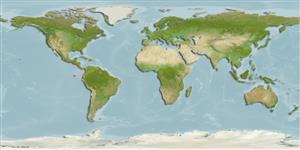
Eastern Central Pacific: Costa Rica to Colombia and the Galapagos Islands.
Größe / Gewicht / Alter
Geschlechtsreife: Lm ? range ? - ? cm
Max length : 8.0 cm TL Männchen/unbestimmt; (Ref. 11482)
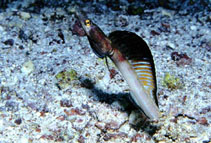
Lives in worm tubes on sand and rubble bottoms (Ref. 11482). Males are territorial and vigorously defend their worm tube homes. When courting, the male will assume the S-shape position and dart quickly back and forth from their place of shelter. When threatened, it opens its enormous mouth, which significantly increases its apparent size to the invader (Ref. 28023).
Lebenszyklus und Paarungsverhalten
Geschlechtsreife | Fortpflanzung | Ablaichen | Eier | Fruchtbarkeit | Larven
Allen, G.R. and D.R. Robertson, 1994. Fishes of the tropical eastern Pacific. University of Hawaii Press, Honolulu. 332 p. (Ref. 11482)
IUCN Rote Liste Status (Ref. 130435: Version 2025-2 (Global))
Bedrohung für Menschen
Harmless
Nutzung durch Menschen
Tools
Zusatzinformationen
Download XML
Internet Quellen
Schätzungen auf der Grundlage von Modellen
Bevorzugte Temperatur (Ref.
123201): 22.3 - 29.1, mean 26.8 °C (based on 251 cells).
Phylogenetischer Diversitätsindex (Ref.
82804): PD
50 = 0.5005 [Uniqueness, from 0.5 = low to 2.0 = high].
Bayesian length-weight: a=0.00102 (0.00046 - 0.00225), b=3.06 (2.88 - 3.24), in cm total length, based on all LWR estimates for this body shape (Ref.
93245).
Trophische Ebene (Ref.
69278): 3.5 ±0.5 se; based on size and trophs of closest relatives
Anfälligkeit der Fischerei (Ref.
59153): Low vulnerability (10 of 100).
🛈