Пластиножаберные (акулы и скаты) (sharks and rays) >
Torpediniformes (Electric rays) >
Torpedinidae (Electric rays)
Etymology: californica: Named after the state of California (Ref. 6885).
More on author: Ayres.
Окружающая среда: среда / климатическая зона / пределы глубины / диапазон распространения
экология
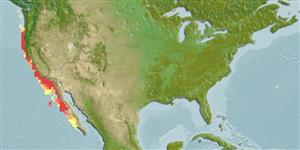
морской демерсальный; пределы глубины 0 - 906 m (Ref. 96339), usually 3 - 200 m (Ref. 55307). Temperate; 48°N - 23°N, 126°W - 110°W (Ref. 55307)
Eastern Pacific: Dixon Entrance, British Columbia, Canada to Sebastian Vizcaino Bay, Baja California, Mexico. Electric rays off Peru, Chile, and Japan may belong to this species (Ref. 2850).
Длина при первой зрелости / Размер / Вес / Возраст
половая зрелость: Lm ?, range 73 - ? cm
Deprecated: number_format(): Passing null to parameter #1 ($num) of type float is deprecated in /var/www/html/includes/common.lib.php on line 1833
Max length : 140 cm TL самец/пол неопределен; (Ref. 12951); 137.0 cm TL (female); common length : 91.0 cm TL самец/пол неопределен; (Ref. 43939); common length :137 cm TL (female); наибольший вес (опубликованные данные): 0.00 g; наибольший возраст (опубликованны данные): 16 годы (Ref. 48844)
Краткое описание
определительные ключи | морфология | морфометрия
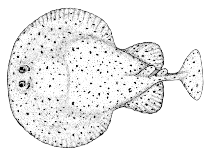
Gray with scattered black spots dorsally, no ocelli. 1st dorsal fin much larger than 2nd. Spiracle margin smooth and without papillae.
Body shape (shape guide): other.
Found on the outer continental shelf, around rocks, in kelp beds, over fine sand bottoms or buried in sand. Solitary, nomadic, and can remain suspended in the water with minimal swimming (Ref. 12951). Feeds on bony fishes, mainly herrings and halibuts. Ovoviviparous (Ref. 50449). Produces litters of up to 17 pups. Males reaches maturity at ca. 65 cm TL, females at ca. 73 cm TL (Ref. 114953). Attacks their prey from the substratum by day and actively forage at night with the aid of its electric organ discharge or EOD (Ref. 10011). The EOD of a large individual was measured at 50 V; with a low internal organ resistance the power output exceeded 1 kW (Ref. 10480). Aggressive when provoked but no human has yet been injured by the electric shock (Ref. 2850). Does not do well in aquariums (Ref. 12951).
Exhibit ovoviparity (aplacental viviparity), with embryos feeding initially on yolk, then receiving additional nourishment from the mother by indirect absorption of uterine fluid enriched with mucus, fat or protein through specialised structures (Ref. 50449).
Reproductive cycle appears to be annual in males and biannual in females (Ref. 48844). No defined birthing season (Ref. 48844).
Allen, M.J. and G.B. Smith, 1988. Atlas and zoogeography of common fishes in the Bering Sea and northeastern Pacific. NOAA Tech. Rep. NMFS 66, 151 p. (Ref. 6793)
Статус Красного Списка МСОП (Ref. 130435: Version 2025-2 (Global))
Использование человеком
дополнительная информация
инструменты
Специальные отчеты
Скачать в формате XML
ресурсы в Интернет
Оценки, основанные на моделях
Предпочтительная температура (ссылка
123201): 8.6 - 22.3, mean 12.8 °C (based on 100 cells).
Индекс филогенетического разнообразия (ссылка
82804): PD
50 = 0.5001 [Uniqueness, from 0.5 = low to 2.0 = high].
Bayesian length-weight: a=0.01479 (0.00678 - 0.03229), b=2.97 (2.78 - 3.16), in cm total length, based on LWR estimates for this (Sub)family-body shape (Ref.
93245).
Трофический уровень (ссылка
69278): 4.5 ±0.80 se; based on food items.
устойчивость к внешним воздействиям (ссылка
120179): низкий, минимальное время удвоения популяции 4.5-14 лет (Fec = 17; tm=9; tmax=16).
Уязвимость рыбной ловли (Ref.
59153): Very high vulnerability (79 of 100).
🛈