Elasmobranquios (tiburones y rayas) (sharks and rays) >
Lamniformes (Mackerel sharks) >
Alopiidae (Thresher sharks)
Etymology: Alopias: From alopex, Greek for fox, referring to the ancient vernacular “fox shark,” from its supposed cunning (ancients believed that when it took a bait, it swallowed the hook until it got to the cord, which it bit off and so escaped) (See ETYFish); vulpinus: Latin for fox-like (as for genus) (See ETYFish).
More on author: Bonnaterre.
Entorno: milieu / zona climática / rango de profundidad / gama de distribución
Ecología
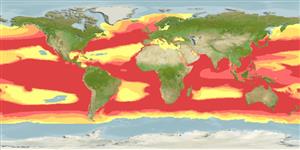
marino pelagic-oceanic; oceanodromo (Ref. 87829); rango de profundidad 0 - 650 m (Ref. 106604), usually 0 - 200 m (Ref. 55168). Subtropical; 74°N - 58°S, 180°W - 180°E (Ref. 54279)
Cosmopolitan in temperate and tropical seas (Ref. 6871, 58085). Population considered reduced (R) in the US Atlantic waters; lower risk/conservation dependent (LR/CD) in US Pacific waters; data deficient (DD) in the rest of Atlantic and rest of Pacific (Ref. 12451). Highly migratory species.
Longitud en la primera madurez / Tamaño / Peso / Edad
Madurez: Lm 351.0, range 226 - 400 cm
Max length : 573 cm TL macho / no sexado; (Ref. 106604); 549.0 cm TL (female); common length : 450 cm TL macho / no sexado; (Ref. 5217); peso máximo publicado: 348.0 kg (Ref. 40637); edad máxima reportada: 25 años (Ref. 81241)
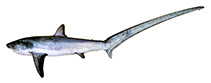
Espinas dorsales (total) : 0; Espinas anales: 0. A large thresher with relatively small eyes, curved, narrow-tipped pectoral fins, a narrow-tipped caudal fin, and a conspicuous white patch over the pectoral fin bases (Ref. 5578). Second dorsal origin well behind the rear tip of the pelvic fin (Ref. 559). Upper lobe of caudal fin very long and strap-like, about as long as or longer than length of rest of shark; lower lobe short but well developed (Ref. 13570). Brown, grey, blue-grey, or blackish on back and underside of snout, lighter on sides and abruptly white below; a white area extends from the abdomen over the pectoral-fin bases; pectoral-, pelvic-, and dorsal fins blackish, white dots sometimes present on pectoral-, pelvic-, and caudal- fin tips (Ref. 13570).
Body shape (shape guide): fusiform / normal; Cross section: circular.
Coastal over continental and insular shelves and epipelagic far from land (Ref. 30573, 43278, 58302). Oceanic although most abundant near land, pelagic at 1-366 m (Ref. 58302). Young often close inshore and in shallow bays (Ref. 5578). Feeds on schooling fishes (including mackerels, bluefishes, clupeids, needlefishes, lancetfishes and lanternfishes), squid, octopi, pelagic crustaceans, and rarely seabirds (Ref. 247). Ovoviviparous, embryos feeding on yolk sac and other ova produced by the mother (Ref. 43278, 50449). Uses its long caudal fin to bunch up and stun prey (Ref. 2850). Spatial and depth segregation by sex in northwestern Indian Ocean populations (Ref. 247). A few attacks on boats are doubtfully attributed to this species, but it is otherwise apparently harmless to humans, though the size of adults of this species command respect (Ref. 247). May cause damage to fishing gear (Ref. 6885). Valued for its meat, liver, hide, and fins; utilized fresh, dried-salted, smoked, and frozen (Ref. 9987).
Ovoviviparous, embryos feed solely on the ova produced by the mother after the yolk sac is absorbed (oophagy) (Ref. 50449), 2 to 4 young in a litter (usually 2) (Ref. 247). Size at birth 114-150 cm (Ref. 247). Distinct pairing with embrace (Ref. 205).
Compagno, L.J.V., 1984. FAO Species Catalogue. Vol. 4. Sharks of the world. An annotated and illustrated catalogue of shark species known to date. Part 1 - Hexanchiformes to Lamniformes. FAO Fish. Synop. 125(4/1):1-249. Rome, FAO. (Ref. 247)
Situación en la Lista Roja de la UICN (Ref. 130435: Version 2025-2 (Global))
Amenaza para el ser humano
Usos humanos
Pesquerías: comercial; pesca deportiva: si
Herramientas
Informes especiales
Descargar XML
Fuentes de Internet
Estimaciones basadas en modelos
Temperatura preferida (Referencia
123201): 11.6 - 28.2, mean 23.3 °C (based on 8352 cells).
Índice de diversidad filogenética (Referencia
82804): PD
50 = 0.7500 [Uniqueness, from 0.5 = low to 2.0 = high].
Bayesian length-weight: a=0.00851 (0.00364 - 0.01988), b=2.86 (2.66 - 3.06), in cm total length, based on LWR estimates for this species & (Sub)family-body (Ref.
93245).
Nivel trófico (Referencia
69278): 4.5 ±0.0 se; based on diet studies.
Generation time: 11.0 ( na - na) years. Estimated as median ln(3)/K based on 2
growth studies.
Resiliencia (Referencia
120179): Bajo, población duplicada en un tiempo mínimo de 4.5-14 años (K=0.1; tm=5-7; tmax=19; Fec=2-4).
Prior r = 0.05, 95% CL = 0.03 - 0.07, Based on 1 full stock assessment.
Vulnerabilidad pesquera (Ref.
59153): Very high vulnerability (77 of 100).
🛈
Vulnerabilidad climática (Ref.
125649): High vulnerability (62 of 100).
🛈
Nutrientes (Ref.
124155): Calcium = 6.93 [1.98, 35.15] mg/100g; Iron = 0.726 [0.178, 2.143] mg/100g; Protein = 20.7 [18.3, 23.1] %; Omega3 = 0.379 [0.152, 0.923] g/100g; Selenium = 37.8 [10.7, 110.5] μg/100g; VitaminA = 4.78 [1.56, 14.81] μg/100g; Zinc = 0.28 [0.14, 0.52] mg/100g (wet weight);