Lớp phụ Cá sụn (cá mập và cá đuối) (sharks and rays) >
Hexanchiformes (Frill and cow sharks) >
Hexanchidae (Cow sharks)
Etymology: Notorynchus: Etymology not explained, presumably noto(s) (Gr.), back, possibly referring to posterior placement of single dorsal fin; rhynchus (L.), snout, possibly referring to broad, depressed snout (See ETYFish); cepedianus: -anus, Latin adjectival suffix that means, when attached to a name, “belonging to”: Bernard Germain Étienne de La Ville-sur-Illon, comte de [count of] La Cepède (also spelled as La Cépède, Lacépède and Lacepède, 1756-1825), author of Histoire Naturelle des Poissons (1798-1803) and Péron’s “illustrious master” (translation) in ichthyology (See ETYFish).
Eponymy: Bernard Germaine Etienne de la Ville, Comte de Lacépède (also spelled La Cepède) (1756– 1825), was a French naturalist and politician. [...] (Ref. 128868), visit book page.
Môi trường: môi trường / vùng khí hậu / Mức độ sâu / phạm vi phân phối
Sinh thái học
biển; thuộc về nước lợ gần đáy; mức độ sâu 0 - 570 m (Ref. 26346), usually ? - 80 m (Ref. 5578). Subtropical; 56°N - 55°S, 131°W - 177°E (Ref. 54680)
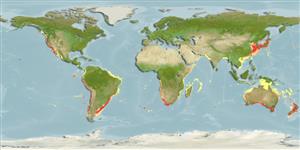
Circumglobal: In tropical to temperate waters; except North Atlantic and Mediterranean Sea. Southwest Atlantic: southern Brazil to northern Argentina. Southeast Atlantic: Namibia to East London, South Africa (Ref. 5578). Western Pacific: southern Japan to New Zealand. Eastern Pacific: British Columbia, Canada to Chile. Record from India maybe erroneous.
Chiều dài lúc trưởng thành đầu tiên / Bộ gần gũi / Khối lượng (Trọng lượng) / Tuổi
Chín muồi sinh dục: Lm 200.0, range 192 - 208 cm
Max length : 300 cm TL con đực/không giới tính; (Ref. 5578); common length : 150 cm TL con đực/không giới tính; (Ref. 6077); Khối lượng cực đại được công bố: 107.0 kg (Ref. 9987); Tuổi cực đại được báo cáo: 49 các năm (Ref. 27952)
Các tia vây lưng cứng (tổng cộng) : 0; Tia cứng vây hậu môn: 0; Động vật có xương sống: 123 - 157. A large seven-gilled cowshark (Ref. 5578) with a wide head, short and blunt snout, and fusiform body. Dorsal fin small, origin may vary from over insertion of pelvic fins to over free rear tips of pelvic fins. Anal fin smaller than dorsal fin. Tooth count 15-16/13. Reddish-brown to silvery-grey or olive-brown with numerous small black spots on body and fins; cream below (Ref. 5578).
Body shape (shape guide): elongated.
Found on the continental shelf, often in shallow water (Ref. 247). Occurs close inshore, in bays and estuaries (Ref. 6871), with larger individuals ranging into deeper waters offshore and deep channels in bays (Ref. 247). Usually cruising steadily and slowly near the bottom (sometimes in water as shallow as a meter), but sometimes at the surface (Ref. 247). Can dash at speed when attacking prey (Ref. 247). Feeds on anything, including other sharks, rays, chimaeras, bony fish, hagfish, dolphin and porpoise meat, seals, shark egg cases, sea snails and mammalian carrion, including rats and humans (Ref. 5578). Ovoviviparous (Ref. 50449), with 82 to 95 young in a litter (Ref. 31395). Aggressive when provoked, and regarded as potentially dangerous to people in open waters (Ref. 247). It has attacked divers in captivity and may be involved in a few shark attacks off California and South Africa (Ref. 247). Often caught by anglers from the shore (Ref. 6574). Utilized for human consumption, its skin for leather, and its liver as a source of oil (Ref. 247).
Ovoviviparous, embryos feeding solely on yolk (Ref. 50449), with number of young reaching 82 in a litter. Gravid females apparently drop their young in shallow bays. Size at birth between 40 (Ref. 26346) and 53 (Ref. 247) cm. Distinct pairing with embrace (Ref. 205). Gestation period 12 months. The reproductive cycle appears to be biennial (Ref. 45445).
Compagno, L.J.V., 1984. FAO Species Catalogue. Vol. 4. Sharks of the world. An annotated and illustrated catalogue of shark species known to date. Part 1 - Hexanchiformes to Lamniformes. FAO Fish. Synop. 125(4/1):1-249. Rome, FAO. (Ref. 247)
Tình trạng Sách đỏ IUCN (Ref. 130435: Version 2025-2 (Global))
Mối đe dọa đối với con người
Sử dụng của con người
Các nghề cá: tính thương mại; cá để chơi: đúng; Bể nuôi cá: Bể cá công cộng
Các công cụ
Báo cáo đặc biệt
Tải xuống XML
Các nguồn internet
Ước tính dựa trên mô hình
Nhiệt độ ưa thích (Tài liệu tham khảo
123201): 7.5 - 19.2, mean 14.2 °C (based on 122 cells).
Chỉ số đa dạng phát sinh loài (Tài liệu tham khảo
82804): PD
50 = 1.0391 [Uniqueness, from 0.5 = low to 2.0 = high].
Bayesian length-weight: a=0.00224 (0.00096 - 0.00523), b=3.15 (2.95 - 3.35), in cm total length, based on LWR estimates for this (Sub)family-body shape (Ref.
93245).
Mức dinh dưỡng (Tài liệu tham khảo
69278): 4.7 ±0.2 se; based on diet studies.
Thích nghi nhanh (Tài liệu tham khảo
120179): Rất thấp, thời gian nhân đôi của chủng quần tối thiểu là hơn 14 năm (rm=0.026; K=0.25; tm=16; tmax=32; Fec=82-95).
Sự dễ bị tổn thương của nghề đánh cá (Ref.
59153): High vulnerability (57 of 100).
🛈
Sự dễ bị tổn thương của khí hậu (Ref.
125649): High vulnerability (64 of 100).
🛈
Chất dinh dưỡng (Ref.
124155): Calcium = 13.3 [2.9, 63.2] mg/100g; Iron = 0.671 [0.165, 1.979] mg/100g; Protein = 20.1 [17.9, 22.2] %; Omega3 = 0.275 [0.123, 0.632] g/100g; Selenium = 43.1 [11.1, 117.0] μg/100g; VitaminA = 5.25 [1.65, 16.47] μg/100g; Zinc = 0.328 [0.161, 0.626] mg/100g (wet weight);