>
Holocentriformes (Squirrelfishes, soldierfishes) >
Holocentridae (Squirrelfishes, soldierfishes) > Holocentrinae
Etymology: Sargocentron: Greek, sargos = sargus + Greek, kentron = sting (Ref. 45335); spinosissimum: Named for its numerous small spines.
More on authors: Temminck & Schlegel.
Ambiente: milieu / zona climatica / distribuzione batimetrica / gamma di distribuzione
Ecologia
marino associati a barriera corallina; distribuzione batimetrica 120 - 230 m (Ref. 27370). Subtropical
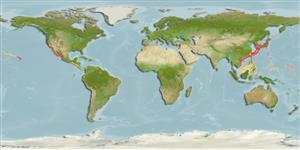
Northwest Pacific: southern Japan to Taiwan; also reported from Hawaii (Ref. 27370). Lessepsian migrant but identificastion to be confirmed (Ref. 124038).
Dimensione / Peso / Età
Maturità: Lm ? range ? - ? cm
Max length : 17.7 cm SL maschio/sesso non determinato; (Ref. 27370)
Breve descrizione
Chiavi di identificazione | Morfologia | Morfometria
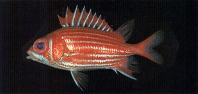
Spine dorsali (totale) : 11 - 77; Raggi dorsali molli (totale) : 12 - 13; Spine anali: 4; Raggi anali molli: 8 - 9. Body with 9 red stripes alternating with 9 narrower white stripes that pass along the middle of the longitudinal scale rows; head red with a white bar along the posterior margin of preopercle. Five oblique scale rows on cheek; body depth 2.45-2.75 in SL; head length (HL) 2.5-2.7 in SL; snout length 3.6-4.0 in HL; large eyes, orbit diameter 2.6-3.1; least interorbital width 4.5-5.1 in HL; maxilla extending from a vertical at front edge of the pupil to slightly beyond the center of the eye, upper jaw length 2.45-2.8 in HL; premaxillary groove usually not reaching a vertical at front edge of the orbit; rounded anterior end of nasal bone; moderately large nasal fossa, often spineless (1 specimen with 1 spinule on anterior edge on one side, another with 2 projecting outward); upper surface of nasal bone with 4-16 small retrorse spines between nasal fossa and edge of premaxillary groove; often 2 or 3 small retrorse spines posteriorly on medial edge of nasal bone (premaxillary groove margin); 2 long opercular spines, the lower about 3/4 length to nearly as long as the upper spine; preopercular spine, 4.45-6.6 in HL; ridge at upper edge of suborbital bones serrate, the serrae decreasing in size posteriorly; 3rd or 4th dorsal spine longest, 1.9-2.25 in HL; 3rd anal spine 1.35-1.6 in HL; rounded caudal fin lobes (Ref. 27370).
Body shape (shape guide): fusiform / normal; Cross section: compressed.
Lives in rocky soil of deep waters (Ref. 9137). Benthopelagic in or near crevices and caves of rocky substrates (Ref. 58302).
Ciclo vitale e comportamento di accoppiamento
Maturità | Riproduzione | Deposizione | Uova | Fecondità | Larve
Randall, J.E., 1998. Revision of the Indo-Pacific squirrelfishes (Beryciformes: Holocentridae: Holocentrinae) of the genus Sargocentron, with descriptions of four new species. Indo-Pac. Fish. (27):105 p. (Ref. 27370)
Stato della Lista Rossa IUCN (Ref. 130435: Version 2025-2 (Global))
Minaccia per l'uomo
Harmless
Usi umani
Strumenti
Rapporti speciali
Scarica XML
Fonti Internet
Stime basate su modelli
Temperatura preferita (Fonte Biblio.
123201): 5.7 - 20.9, mean 16.9 °C (based on 47 cells).
Indice di diversità filogenetica (Fonte Biblio.
82804): PD
50 = 0.5000 [Uniqueness, from 0.5 = low to 2.0 = high].
Bayesian length-weight: a=0.01698 (0.00810 - 0.03560), b=2.96 (2.79 - 3.13), in cm total length, based on LWR estimates for this Genus-body shape (Ref.
93245).
Livello trofico (Fonte Biblio.
69278): 4.0 ±0.66 se; based on food items.
Resilienza (Fonte Biblio.
120179): Alto, tempo minimo di raddoppiamento della popolazione meno di 15 mesi (Preliminary K or Fecundity.).
Vulnerabilità della pesca (Ref.
59153): Low vulnerability (12 of 100).
🛈