Klassifizierung / Names
Namen | Synonyme | Catalog of Fishes(Gattung, Arten) | ITIS | CoL | WoRMS | Cloffa
>
Salmoniformes (Salmons) >
Salmonidae (Salmonids) > Coregoninae
Etymology: Coregonus: Greek, kore = pupils of the eye + Greek, gonia = angle (Ref. 45335).
More on author: Linnaeus.
Umwelt: Milieu / Klimazone / Tiefenbereich / Verbreitungsgebiet
Ökologie
; süßwasser; brackwasser demersal; pH range: 7.0 - 7.5; dH range: 20 - ?; anadrom (Ref. 138280). Temperate; 4°C - 16°C (Ref. 2059); 52°N - 43°N, 6°W - 11°E
Europe: Native to Lake Bourget (France) and Geneva (Switzerland, France). Population of Lake Aiguebelette (France) apparently introduced, but a 'lavaret' had already been recorded from there in the 17th century (Ref. 59043). Other authors assume it to be a superspecies occurring in Great Britain and Alpine areas of Central Europe. Has been stocked into many other places in Europe outside its native range. There are many parallel and wrong scientific names for this species in use because of the problems in classifying the genus Coregonus (Ref. 7495). Asia: introduced to Iran (Ref. 39702).
Länge bei der ersten Reifung / Größe / Gewicht / Alter
Geschlechtsreife: Lm 27.1, range 40 - ? cm
Max length : 73.0 cm TL Männchen/unbestimmt; (Ref. 40637); max. veröff. Gewicht: 10.0 kg (Ref. 35388)
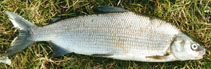
Rückenflossenstacheln (insgesamt) : 3 - 5; Rückenflossenweichstrahlen (insgesamt) : 9 - 12; Afterflossenstacheln: 3 - 5; Afterflossenweichstrahlen: 10 - 13. Mouth small with protruding upper jaw. Silvery body (Ref. 35388). Caudal fin with 19 soft rays (Ref. 40476).
Body shape (shape guide): fusiform / normal.
Gregarious lacustrine forms (Ref. 2163) and anadromous estuarine forms, rarely in full saltwater. Adults feed on planktonic crustaceans, or larger benthic crustaceans in brackish water. Movement in water column as a function of zooplankton repartition (Ref. 2163). Spawning occurs in gravel, near shore, in shallow water, in December (Ref. 59043). Likely to benefit from environmental regulations in France passed on 8/12/88 (Ref. 2163).
Spawning takes place at night.
Wheeler, A., 1992. A list of the common and scientific names of fishes of the British Isles. J. Fish Biol. 41(suppl.A):1-37. (Ref. 5204)
IUCN Rote Liste Status (Ref. 130435: Version 2025-2 (Global))
Bedrohung für Menschen
Harmless
Nutzung durch Menschen
Fischereien: kommerziell; Aquakultur: kommerziell; Sportfisch: ja
Tools
Zusatzinformationen
Download XML
Internet Quellen
Schätzungen auf der Grundlage von Modellen
Bevorzugte Temperatur (Ref.
123201): 5.8 - 12.5, mean 9.5 °C (based on 528 cells).
Phylogenetischer Diversitätsindex (Ref.
82804): PD
50 = 0.5000 [Uniqueness, from 0.5 = low to 2.0 = high].
Bayesian length-weight: a=0.00447 (0.00377 - 0.00529), b=3.20 (3.16 - 3.24), in cm total length, based on LWR estimates for this species (Ref.
93245).
Trophische Ebene (Ref.
69278): 3.1 ±0.0 se; based on diet studies.
Widerstandsfähigkeit (Ref.
120179): mittel, Verdopplung der Population dauert 1,4 - 4,4 Jahre. (K=0.3-0.7; tmax=8; Fecundity=3,800 - 169,800).
Anfälligkeit der Fischerei (Ref.
59153): Moderate to high vulnerability (51 of 100).
🛈
Klimaanfälligkeit (Ref.
125649): High to very high vulnerability (72 of 100).
🛈
Nährstoffe (Ref.
124155): Calcium = 20.4 [11.3, 32.4] mg/100g; Iron = 0.335 [0.226, 0.476] mg/100g; Protein = 18.4 [17.4, 19.4] %; Omega3 = 1.06 [0.46, 2.79] g/100g; Selenium = 17.1 [8.9, 38.7] μg/100g; VitaminA = 6.28 [2.85, 14.43] μg/100g; Zinc = 0.552 [0.447, 0.674] mg/100g (wet weight); based on
nutrient studies.