>
Salmoniformes (Salmons) >
Salmonidae (Salmonids) > Coregoninae
Etymology: Coregonus: Greek, kore = pupils of the eye + Greek, gonia = angle (Ref. 45335).
More on author: Linnaeus.
Environnement : milieu / zone climatique / profondeur / gamme de distribution
Écologie
; eau douce; saumâtre démersal; pH range: 7.0 - 7.5; dH range: 20 - ?; anadrome (Ref. 138280). Temperate; 4°C - 16°C (Ref. 2059); 52°N - 43°N, 6°W - 11°E
Europe: Native to Lake Bourget (France) and Geneva (Switzerland, France). Population of Lake Aiguebelette (France) apparently introduced, but a 'lavaret' had already been recorded from there in the 17th century (Ref. 59043). Other authors assume it to be a superspecies occurring in Great Britain and Alpine areas of Central Europe. Has been stocked into many other places in Europe outside its native range. There are many parallel and wrong scientific names for this species in use because of the problems in classifying the genus Coregonus (Ref. 7495). Asia: introduced to Iran (Ref. 39702).
Longueur à la première maturité / Taille / Poids / Âge
Maturité: Lm 27.1, range 40 - ? cm
Max length : 73.0 cm TL mâle / non sexé; (Ref. 40637); poids max. publié: 10.0 kg (Ref. 35388)
Description synthétique
Clés d'identification | Morphologie | Morphométrie
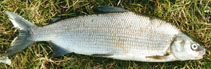
Épines dorsales (Total) : 3 - 5; Rayons mous dorsaux (Total) : 9 - 12; Épines anales: 3 - 5; Rayons mous anaux: 10 - 13. Mouth small with protruding upper jaw. Silvery body (Ref. 35388). Caudal fin with 19 soft rays (Ref. 40476).
Body shape (shape guide): fusiform / normal.
Gregarious lacustrine forms (Ref. 2163) and anadromous estuarine forms, rarely in full saltwater. Adults feed on planktonic crustaceans, or larger benthic crustaceans in brackish water. Movement in water column as a function of zooplankton repartition (Ref. 2163). Spawning occurs in gravel, near shore, in shallow water, in December (Ref. 59043). Likely to benefit from environmental regulations in France passed on 8/12/88 (Ref. 2163).
Spawning takes place at night.
Wheeler, A., 1992. A list of the common and scientific names of fishes of the British Isles. J. Fish Biol. 41(suppl.A):1-37. (Ref. 5204)
Statut dans la liste rouge de l'IUCN (Ref. 130435: Version 2025-2 (Global))
Menace pour l'homme
Harmless
Utilisations par l'homme
Pêcheries: commercial; Aquaculture: commercial; pêche sportive: oui
Outils
Articles particuliers
Télécharger en XML
Sources Internet
Estimations basées sur des modèles
Température préférée (Réf.
123201): 5.8 - 12.5, mean 9.5 °C (based on 528 cells).
Indice de diversité phylogénétique (Réf.
82804): PD
50 = 0.5000 [Uniqueness, from 0.5 = low to 2.0 = high].
Bayesian length-weight: a=0.00447 (0.00377 - 0.00529), b=3.20 (3.16 - 3.24), in cm total length, based on LWR estimates for this species (Ref.
93245).
Niveau trophique (Réf.
69278): 3.1 ±0.0 se; based on diet studies.
Résilience (Réf.
120179): Milieu, temps minimum de doublement de population : 1,4 à 4,4 années (K=0.3-0.7; tmax=8; Fecundity=3,800 - 169,800).
Vulnérabilité de la pêche (Ref.
59153): Moderate to high vulnerability (51 of 100).
🛈
Vulnérabilité climatique (Ref.
125649): High to very high vulnerability (72 of 100).
🛈
Nutriments (Ref.
124155): Calcium = 20.4 [11.3, 32.4] mg/100g; Iron = 0.335 [0.226, 0.476] mg/100g; Protein = 18.4 [17.4, 19.4] %; Omega3 = 1.06 [0.46, 2.79] g/100g; Selenium = 17.1 [8.9, 38.7] μg/100g; VitaminA = 6.28 [2.85, 14.43] μg/100g; Zinc = 0.552 [0.447, 0.674] mg/100g (wet weight); based on
nutrient studies.